


11 March 2026

5 min read
Hardware Emulation in Modern VLSI Verification: Enabling Hardware–Software Co-Development and Reducing Costly Silicon Respins
-Dhairya Bapodra
11 March 2026
5 min read
Hardware Emulation in Modern VLSI Verification: Enabling Hardware–Software Co-Development and Reducing Costly Silicon Respins
-Dhairya Bapodra
Abstract
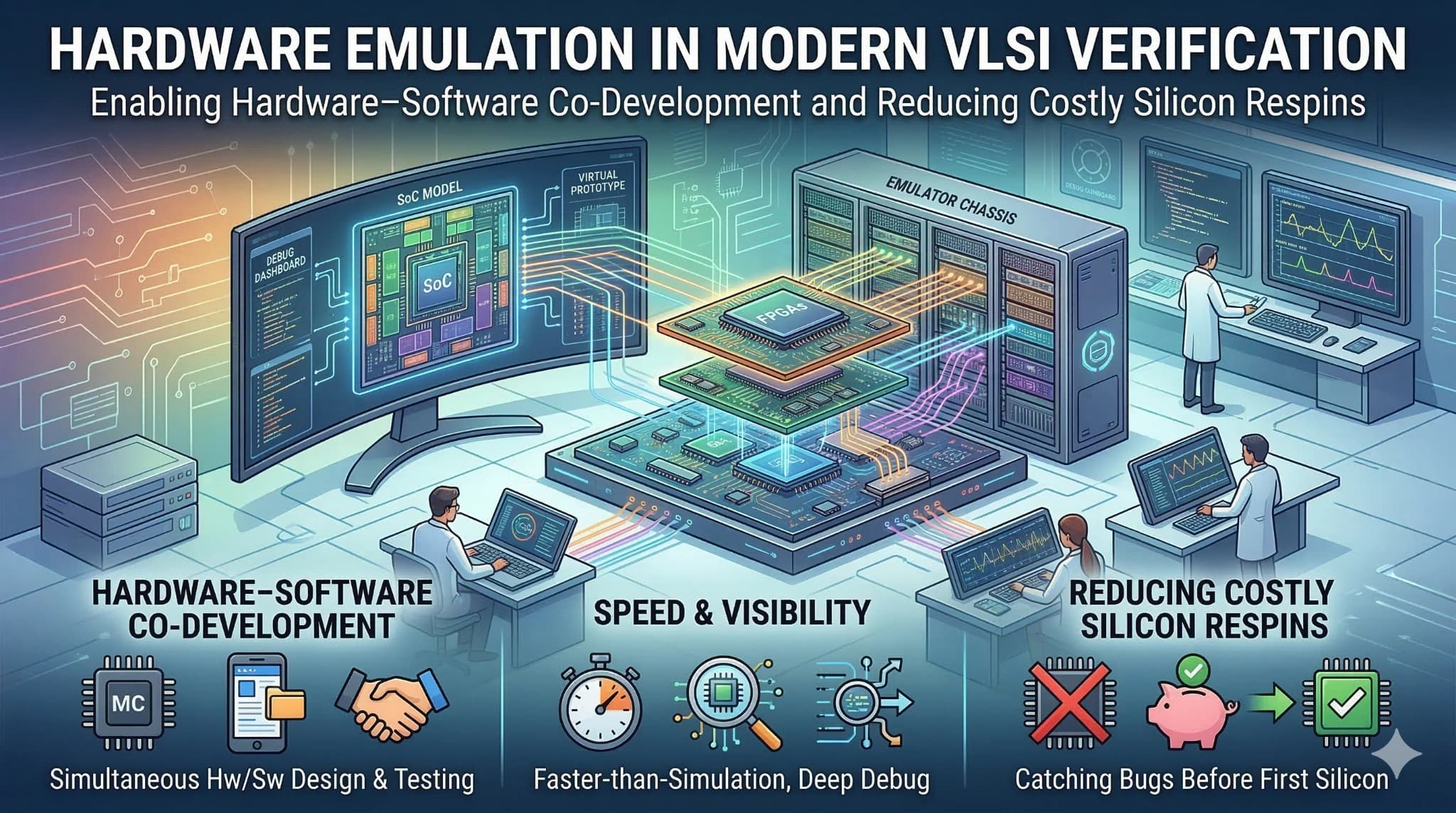
As semiconductor systems continue to increase in complexity, traditional verification approaches such as RTL simulation and post-silicon validation are no longer sufficient to ensure product quality within aggressive development schedules. Modern System-on-Chip (SoC) designs now integrate billions of transistors, heterogeneous compute engines, advanced memory subsystems, high-speed interfaces, and extensive software stacks, all of which must be validated before tape-out.
In this environment, hardware emulation has become a foundational verification technology. By combining near-real-time execution speed with deep internal visibility, emulation enables engineers to validate hardware and software interactions far earlier than is possible with conventional simulation alone. Its value is especially pronounced in designs where core functional blocks are reused across generations, but system-level interconnectivity, memory architecture, and platform integration continue to evolve. These conditions are increasingly common in derivative SoCs, chiplet-based architectures, and platform reuse strategies.
This white paper examines the role of hardware emulation in modern VLSI verification, with emphasis on system integration, software enablement, and economic risk reduction. It discusses emulation architectures, verification workflows, hardware–software co-development, and the strategic importance of shifting validation earlier in the product lifecycle. The paper argues that, particularly at advanced process nodes, hardware emulation is not simply a productivity enhancement but a necessary capability for reducing verification risk, accelerating software readiness, and avoiding costly silicon respins.
1. Introduction
Semiconductor development has undergone a profound shift over the past two decades. Modern SoCs integrate a broad set of subsystems, including CPUs, GPUs, AI accelerators, advanced memory controllers, networking interfaces, security engines, and increasingly complex firmware and operating systems. As this integration has grown, verification has become the dominant component of the overall development effort, often accounting for the majority of project time, engineering resources, and schedule risk.
Traditional verification methods remain important, but each has clear limitations. RTL simulation offers excellent observability and strong debug capability, yet its execution speed is too slow for long-running software and system-level scenarios. FPGA prototyping provides much faster execution, but internal visibility is limited and debugging is significantly more difficult. Post-silicon validation provides access to real hardware, but by that stage any major bug has become far more expensive to diagnose and correct.
Hardware emulation addresses the gap between these approaches. It delivers substantially higher performance than simulation while retaining much of the observability needed for effective debug. More importantly, it enables software to run on a realistic pre-silicon hardware platform, bringing hardware and software verification into the same timeframe. This capability has become increasingly important as verification challenges shift away from isolated block functionality and toward system-level connectivity, platform integration, and hardware–software interaction.
2. Changing Verification Demands
The traditional semiconductor development flow was largely sequential. RTL design was followed by simulation-based verification, then tape-out, silicon bring-up, and finally full software enablement. Although workable in simpler generations of silicon, this model introduced fundamental inefficiencies. Software teams often had to wait for the first silicon before meaningful platform development could begin, while integration issues remained hidden until very late in the schedule. As a result, costly delays and silicon respins became common.
These limitations are no longer acceptable at advanced technology nodes. At 5nm, 3nm, and below, a single mask set can cost tens of millions of dollars. Under those conditions, a respin is not just an engineering setback; it is a major financial and strategic event. This reality has driven the adoption of shift-left methodologies, in which validation, software readiness, and system analysis are moved earlier in the lifecycle. Hardware emulation is central to this transition because it allows teams to validate complex behavior before silicon exists, rather than after the window for affordable correction has closed.
3. Fundamentals of Hardware Emulation
Hardware emulation executes RTL on specialized programmable hardware rather than in a purely software-based simulation engine. This architectural distinction enables emulators to run designs at speeds in the MHz range, a substantial improvement over the Hz to KHz performance typical of simulation. At the same time, emulation platforms preserve a level of design visibility that is far superior to what is normally available in FPGA prototypes.
The practical significance of this combination is considerable. Emulation provides enough speed to boot operating systems, execute firmware, and run system-level workloads, while still allowing engineers to inspect waveforms, transactions, and internal design state when failures occur. In effect, it creates a verification environment that is both executable and observable, making it one of the few pre-silicon platforms capable of supporting realistic end-to-end validation.
4. Emulation Architectures
Hardware emulation platforms are generally built using either FPGA-based implementations or custom emulation hardware. FPGA-based approaches can provide flexibility and a lower initial cost, particularly in smaller-scale or specialized environments. However, they often face limitations in compilation speed, debug depth, and timing closure, especially as design size and complexity increase.
In contrast, commercial high-capacity emulators typically rely on dedicated hardware optimized specifically for emulation workloads. These systems offer larger design capacity, faster compile and load times, richer debug infrastructure, and support for shared multi-user environments. For large SoCs and complex subsystem integration, these characteristics make dedicated emulation systems significantly more effective than FPGA-based alternatives.
5. Why Connectivity Verification Matters More Than Ever
One of the defining characteristics of modern SoC development is the reuse of functional blocks across multiple generations. CPU clusters, GPUs, AI accelerators, and interface subsystems are often carried forward with only incremental changes to internal logic. What changes more substantially is the way these blocks are connected within the broader platform.
Those changes may involve revised memory hierarchies, new interconnect fabrics, updated protocol layers, additional I/O interfaces, or new chiplet arrangements. While such modifications may seem less dramatic than a ground-up functional redesign, they often introduce the most difficult verification problems. The challenge is no longer confined to proving that individual blocks operate correctly in isolation. Instead, teams must verify that data movement, coherency, arbitration, protocol behavior, and software-driven interactions remain correct across the entire system.
This is where hardware emulation becomes particularly valuable. Connectivity-related bugs frequently appear only under realistic operating conditions, when multiple subsystems are active and software is exercising the platform in ways that are difficult to reproduce in simulation. Deadlocks, coherency failures, protocol mismatches, quality-of-service issues, and routing errors are fundamentally system behaviors. They require system-level validation, and emulation provides one of the few practical ways to achieve it before tape-out.
6. Enabling Hardware–Software Co-Development
Perhaps the most strategic benefit of hardware emulation is that it removes the strict sequencing between hardware completion and software development. In traditional flows, software teams are forced to wait until silicon or, at best, late-stage prototypes become available. This delays driver development, operating system bring-up, platform validation, and application readiness.
Emulation changes this model by providing a usable pre-silicon target for the software stack. Firmware teams can begin boot code development early. Operating system and hypervisor teams can validate initialization flows and hardware interfaces. Driver developers can exercise interrupt handling, DMA behavior, memory mapping, and error paths. Networking and AI software stacks can be brought up in parallel with ongoing hardware verification.
This concurrency produces two important benefits. First, it shortens the overall product development timeline by allowing software and hardware workstreams to progress simultaneously. Second, it exposes hardware–software interface bugs far earlier than would otherwise be possible. These are precisely the bugs that can be most disruptive in post-silicon bring-up, yet they are often invisible in conventional simulation environments.
7. Detecting Bugs at the Hardware–Software Boundary
Many of the most consequential modern design failures do not reside purely in hardware or purely in software. They emerge at the interface between the two. Incorrect register definitions, interrupt-routing mistakes, cache coherency violations, DMA synchronization failures, and mismatched timing assumptions are all examples of issues that may remain hidden until real firmware and drivers interact with the platform.
Simulation is often too slow and too constrained to expose these behaviors comprehensively. By contrast, hardware emulation enables realistic software execution at meaningful scale, allowing such failures to surface under conditions that more closely resemble real product usage. This not only improves bug discovery, but also makes root-cause analysis more efficient because the engineer still retains access to pre-silicon debug instrumentation.
8. System-Level Validation with Realistic Workloads
The true power of hardware emulation emerges when the platform is used not simply as a faster simulator, but as a system-level validation environment. In a mature emulation setup, the RTL design is combined with memory models, interface models, software workloads, and verification monitors to create a platform that behaves much like the final silicon. This enables validation of integrated system behavior rather than isolated functional correctness.
Such environments can execute representative workloads, including AI processing flows, networking traffic scenarios, multimedia pipelines, and data-center-style traffic patterns. Running realistic workloads matters because many failures occur only under sustained contention, concurrency, or software-driven system stress. Performance bottlenecks, protocol corner cases, resource starvation, and interconnect congestion are much more likely to surface under representative workload execution than under narrowly scoped directed tests.
9. Debug and Observability Advantages
One of the major distinctions between hardware emulation and FPGA prototyping is debug capability. FPGA prototypes may offer speed, but they generally provide limited internal visibility and can be cumbersome to instrument when failures occur. Emulation platforms, by contrast, are designed to preserve observability while still delivering significant acceleration.
Capabilities such as waveform capture, transaction tracing, memory inspection, and protocol-aware analysis greatly improve the efficiency of failure investigation. This matters because system-level bugs are often intermittent, multi-domain, and difficult to reproduce. The ability to capture and inspect internal design behavior before silicon exists can dramatically reduce debug time and improve verification closure.
10. Performance Insight Before Tape-Out
In addition to functional validation, hardware emulation can provide valuable pre-silicon performance insight. Teams can analyze memory bandwidth utilization, interconnect pressure, cache behavior, latency hotspots, and contention across shared resources. These insights are particularly useful when an architecture is functionally correct but operationally imbalanced.
By identifying such bottlenecks before fabrication, engineering teams can refine the design at a stage when changes are still feasible. This is especially important in high-performance SoCs, where post-silicon performance surprises can be just as damaging as functional bugs.
11. Integration with Verification Infrastructure
Emulation is most effective when it is integrated into the broader verification methodology rather than treated as an isolated environment. It can be connected with UVM-based testbench infrastructure, protocol checkers, coverage tools, and software debug frameworks to create a more continuous verification flow from block-level validation through system-level execution.
This integration helps organizations preserve methodology consistency, reuse infrastructure, and align verification metrics across environments. It also enables teams to move more smoothly from simulation into acceleration and full emulation, rather than maintaining disconnected workflows that increase overhead and reduce productivity.
12. Acceleration and Hybrid Verification Modes
Many hardware emulation platforms support acceleration modes in which portions of the verification environment remain in software while the RTL executes on emulation hardware. This hybrid model provides a practical compromise between speed and flexibility. Software-based testbench components can continue to operate with relatively low disruption, while the most performance-critical part of the workload is accelerated in hardware.
This approach is especially useful for organizations seeking to extend their existing verification environments into emulation without fully rebuilding their methodology. It also broadens the accessibility of emulation by allowing more gradual adoption across teams.
13. Shared and Multi-User Environments
As emulation platforms grow in capacity and strategic importance, they are increasingly deployed as shared infrastructure across multiple teams and projects. Modern systems often support partitioning, concurrent test execution, and access by geographically distributed engineering groups. These features improve asset utilization and make emulation a scalable organizational resource rather than a project-specific tool.
In large semiconductor companies, this shared model also supports better collaboration across hardware, verification, firmware, and software teams. Emulation becomes a common execution environment through which multiple disciplines can align their validation efforts.
14. Economic Value and Risk Reduction
The financial case for hardware emulation becomes clear when viewed in the context of advanced semiconductor economics. Leading-edge mask costs can range from roughly $20 million to $50 million, engineering costs can easily exceed $10 million, and delayed product introduction can result in substantial lost revenue. When those factors are combined, the total impact of a serious silicon respin can reach tens of millions of dollars or more.
Against that backdrop, the cost of emulation infrastructure is best understood as risk mitigation. Emulation reduces the probability of late-stage integration failures, software incompatibilities, and performance surprises by exposing them when the design is still correctable. In many cases, preventing a single major respin or schedule slip is enough to justify the investment.
15. Compressing the Development Timeline
Beyond risk reduction, hardware emulation can materially shorten the development cycle. Without emulation, the program flow tends to remain sequential: hardware design progresses to tape-out, silicon arrives, and software then begins full platform enablement. With emulation, hardware and software development can proceed in parallel, enabling earlier software maturity and smoother bring-up once silicon becomes available.
For complex SoC programs, this parallelism can reduce schedule duration by several months and, in some cases, by as much as six to twelve months. The benefit is not merely faster completion, but better synchronization across teams and a lower concentration of risk late in the schedule.
16. Connectivity-Driven SoC Evolution: A Practical Example
A useful illustration is a second-generation SoC in which the core compute engines remain largely unchanged, but the surrounding platform evolves. The new version may incorporate a revised memory controller, additional PCIe interfaces, a modified interconnect topology, and integration of a new AI accelerator. Although these changes do not necessarily require re-verification of every compute block from first principles, they introduce a large number of new interaction paths throughout the system.
Hardware emulation enables these paths to be exercised under realistic conditions, allowing teams to validate not just functional connectivity but also concurrency, coherency, and software-visible behavior. In such scenarios, the value of emulation lies less in re-proving stable logic and more in validating that system evolution has not introduced hidden integration failures.
17.Chiplets, Security, and Power as Emerging Verification Frontiers
The increasing adoption of chiplet architectures adds yet another layer of verification complexity. Die-to-die communication, protocol adaptation, package-level routing, and latency variability all create new system-level challenges that cannot be addressed adequately through conventional block-level methods alone. Emulation provides a practical environment for validating these interactions before manufacturing.
The same is true for security and power-related behavior. Security vulnerabilities often emerge through hardware–software interaction, including privilege management, isolation breakdowns, and unintended side channels. Power-management issues can arise through incorrect state transitions, dynamic voltage behavior, or workload-dependent thermal effects. While emulation is not a complete replacement for specialized signoff flows, it gives engineering teams earlier visibility into classes of issues that are otherwise difficult to detect until much later.
18. Future Direction of Hardware Emulation
Hardware emulation continues to evolve in response to the increasing scale and complexity of semiconductor systems. Cloud-enabled access models are making it easier for globally distributed teams to share large emulation resources. AI-assisted analysis is beginning to help engineers process trace data and identify anomalies more efficiently. Standardized chiplet ecosystems will likely expand the role of emulation in interoperability testing. At the same time, software-defined orchestration is making emulation environments easier to automate, schedule, and integrate into broader development infrastructure.
These trends suggest that emulation will become even more deeply embedded in mainstream semiconductor workflows, not only as a verification platform but as a shared development environment spanning hardware, firmware, software, and system architecture.
19. Best Practices and Practical Challenges
To fully realize the value of hardware emulation, organizations must treat it as a strategic part of the development process rather than as a late-stage debug resource. The greatest returns are achieved when software enablement starts early, realistic workloads are used, connectivity scenarios are prioritized, and emulation is integrated into continuous verification workflows. Shared resource planning is also essential so that teams can access emulation efficiently without turning it into a bottleneck.
At the same time, practical challenges remain. Emulation platforms require significant capital investment, large designs may still involve long compile cycles, and verification environments often need adaptation to run efficiently in acceleration or emulation mode. Yet these constraints are usually modest when compared with the cost of major silicon escapes, delayed software readiness, or late-stage architectural surprises.
20. Conclusion
As semiconductor systems become more integrated, software-dependent, and connectivity-driven, verification must extend beyond the limits of traditional RTL simulation. The challenge is no longer simply to prove the correctness of individual blocks, but to validate how complete systems behave under realistic software and workload conditions before tape-out.
Hardware emulation addresses this need by combining speed, observability, and software execution in a single pre-silicon platform. It enables earlier system-level validation, supports parallel hardware–software development, improves debug efficiency, and provides performance insight before manufacturing. Most importantly, it reduces the risk of the late-stage failures that lead to costly silicon respins and delayed product launches.
For organizations building next-generation SoCs, hardware emulation is no longer optional infrastructure reserved for the most complex projects. It has become a strategic capability for delivering reliable silicon on schedule, reducing financial exposure, and sustaining competitive development velocity in an increasingly demanding semiconductor landscape.
Appendix A: Glossary of Terms
- **ASIC: ** stands for Application-Specific Integrated Circuit and refers to a chip customized for a particular application or market need.
- **Chiplet: ** refers to a modular die designed to be integrated with other chiplets in a package to form a complete SoC or multi-die system.
- **DMA: ** or Direct Memory Access, allows hardware subsystems to access system memory independently of the CPU.
- **CI/CD: ** means Continuous Integration and Continuous Deployment, a set of practices used to improve the speed and reliability of development and release workflows.
- **FPGA: ** stands for Field-Programmable Gate Array and refers to an integrated circuit that can be configured after manufacturing.
- **QoS: ** or Quality of Service, refers to mechanisms used to guarantee performance levels for selected traffic or services.
- **RTL: ** means Register-Transfer Level, a hardware design abstraction that models digital logic in terms of data movement between registers.
- **Respin: ** refers to the process of correcting a manufactured chip by creating a revised mask set and fabricating silicon again.
- **SoC: ** stands for System-on-Chip and describes an integrated circuit that combines major system functions onto a single device.
- **Tape-out: ** is the final stage of chip design in which the completed design is released for fabrication.
- **UVM: ** or Universal Verification Methodology, is a widely used standardized framework for digital verification.
- **VLSI: ** means Very-Large-Scale Integration and refers to the process of integrating large numbers of transistor-based circuits onto a single chip.
References
- Smith, J. et al. The Verification Tipping Point: Costs and Challenges in Modern SoC Development. IEEE Design & Test, 2021.
- Mentor Graphics. Hardware Emulation: A Path to Shift-Left Verification. White Paper, 2019.
- Synopsys. Accelerating Software Development with High-Performance Emulation. Technical Journal, 2022.
- Cadence Design Systems. Emulation for Chiplet Architecture Validation. Industry Presentation, 2023.
About Author
Dhairya Bapodra is a seasoned semiconductor engineering leader with deep expertise across front-end RTL execution and a strong command of driving programs from specification to first-pass silicon success. As Senior Director, VLSI at Aerlync Labs, Inc., he brings over 16 years of industry experience spanning RTL design, ASIC/SoC verification, and emulation. He leads end-to-end verification and silicon validation strategy, scaling global teams and deploying AI-assisted methodologies to accelerate complex silicon programs with predictable execution. Having operated on both sides of the semiconductor services ecosystem—as both a service provider and a customer—he brings a distinctive perspective on delivery excellence, accountability, and aligning engineering execution with real-world silicon program needs.Dhairya began his career as an RTL Designer at SiBridge Technologies (now part of Cadence) and Uniquify, followed by consulting roles at Mirafra Technologies and PerfectVIPs, supporting silicon programs at Cisco, Barefoot Networks (now part of Intel), and Microsoft. He later held full-time engineering and leadership roles at Mentor Graphics (now Siemens), NVIDIA (across two tenures), and Astera Labs—joining during its early high-growth phase with fewer than 50 employees. Through Mentor, he supported strategic programs at Palo Alto Networks, Juniper Networks (now part of HPE), and Xilinx (now part of AMD).
Recommended Blogs
16 Jun 2026
5 min read
The Connected Device Revolution: Why Engineering Complexity Is Increasing Faster Than Ever

14 May 2025
5 min read
Exploring Zephyr RTOS: A Lightweight, Scalable Real-Time Operating System for the Modern IoT Era
15 Oct 2025
5 min read
Edge AI: Intelligence at the Frontier of Computing
Build with the Most Trusted Engineering Partner

Delivers cutting-edge embedded solutions, from firmware development to wireless protocols, ensuring reliability and innovation.

Resources
Copyright © 2026
Privacy Policy
Terms of Service
Delivers cutting-edge embedded solutions, from firmware development to wireless protocols, ensuring reliability and innovation.


Resources
Privacy Policy
Terms of Service
Copyright © 2026