


15 Oct 2025

5 min read
Edge AI: Intelligence at the Frontier of Computing
--Team Aerlync
15 Oct 2025
5 min read
Edge AI: Intelligence at the Frontier of Computing
--Team Aerlync
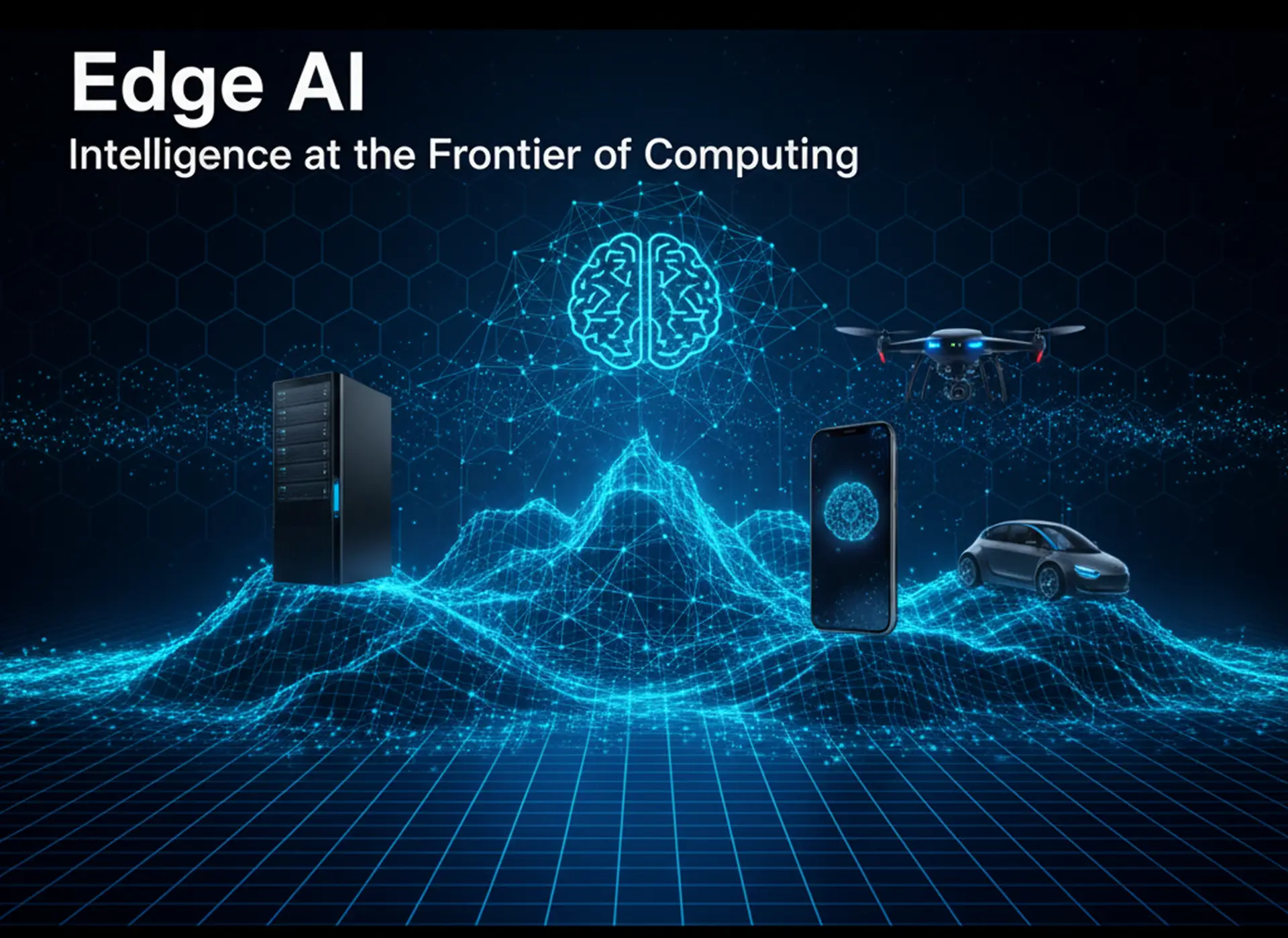
Artificial Intelligence (AI) has largely been driven by the cloud — powerful servers processing massive datasets and running deep learning models at scale. But as billions of connected devices emerge across industries, a new paradigm has taken center stage: Edge AI.
Edge AI brings computation, learning, and decision-making closer to where data is generated — at the “edge” of the network — enabling faster responses, better privacy, and more efficient bandwidth usage. It is the invisible intelligence powering autonomous drones, connected vehicles, surveillance cameras, medical wearables, and industrial automation systems.
This blog explores the fundamentals, architecture, applications, challenges, and economics of Edge AI — and why it represents the next trillion-dollar frontier in digital transformation.
1. What Is Edge AI?
Edge AI refers to the deployment of AI models directly on edge devices, such as embedded boards, sensors, or gateways, rather than relying on cloud data centers. In this architecture, data is processed locally using neural network accelerators or specialized AI chips, allowing decisions to be made in milliseconds.
For example, a smart security camera running an object detection model can instantly identify motion or intruders without uploading video streams to the cloud. This improves real-time responsiveness while reducing latency, network congestion, and privacy risks.
According to McKinsey (2023), around 60 percent of enterprise data is now generated outside traditional data centers or clouds — and Edge AI is becoming the default way to manage and act on this distributed intelligence.
2. Why Edge AI Matters
a. Latency Reduction
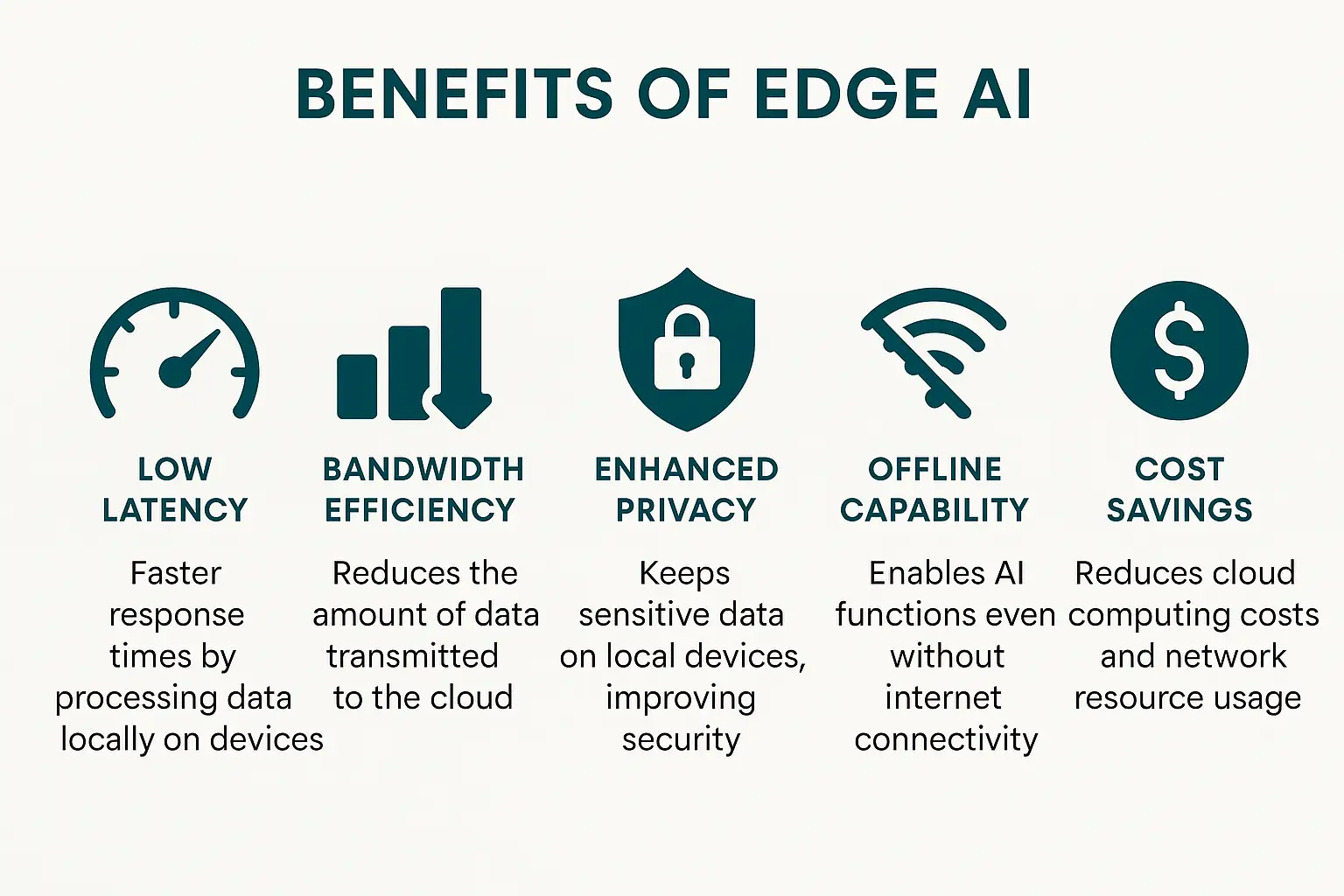
Cloud-based AI can experience delays due to data transmission. In autonomous systems such as drones, robotic arms, or self-driving cars, milliseconds can mean the difference between success and failure. By performing inference locally, Edge AI reduces latency from hundreds of milliseconds to a few milliseconds, enabling real-time decision-making.
b. Privacy and Data Sovereignty
Edge processing minimizes the need to transmit raw personal or operational data to remote servers. This aligns with global privacy regulations like GDPR (Europe) and DPDP Act (India), ensuring compliance and lowering data exposure risks.
c. Bandwidth and Cost Optimization
Transmitting high-resolution sensor data to the cloud is expensive and impractical at scale. Edge inference significantly reduces bandwidth consumption, resulting in cost-efficient and sustainable architectures for IoT systems.
d. Energy Efficiency and Autonomy
Battery-powered devices, such as surveillance drones or industrial robots, benefit from on-device AI chips (NPUs, TPUs, or DSPs) optimized for low power consumption, allowing continuous operation without cloud dependency.
e. Offline Capability
Edge AI devices can continue to function and make intelligent decisions even when they are not connected to the internet, making them more reliable in areas with poor connectivity.
3. Core Architecture of Edge AI
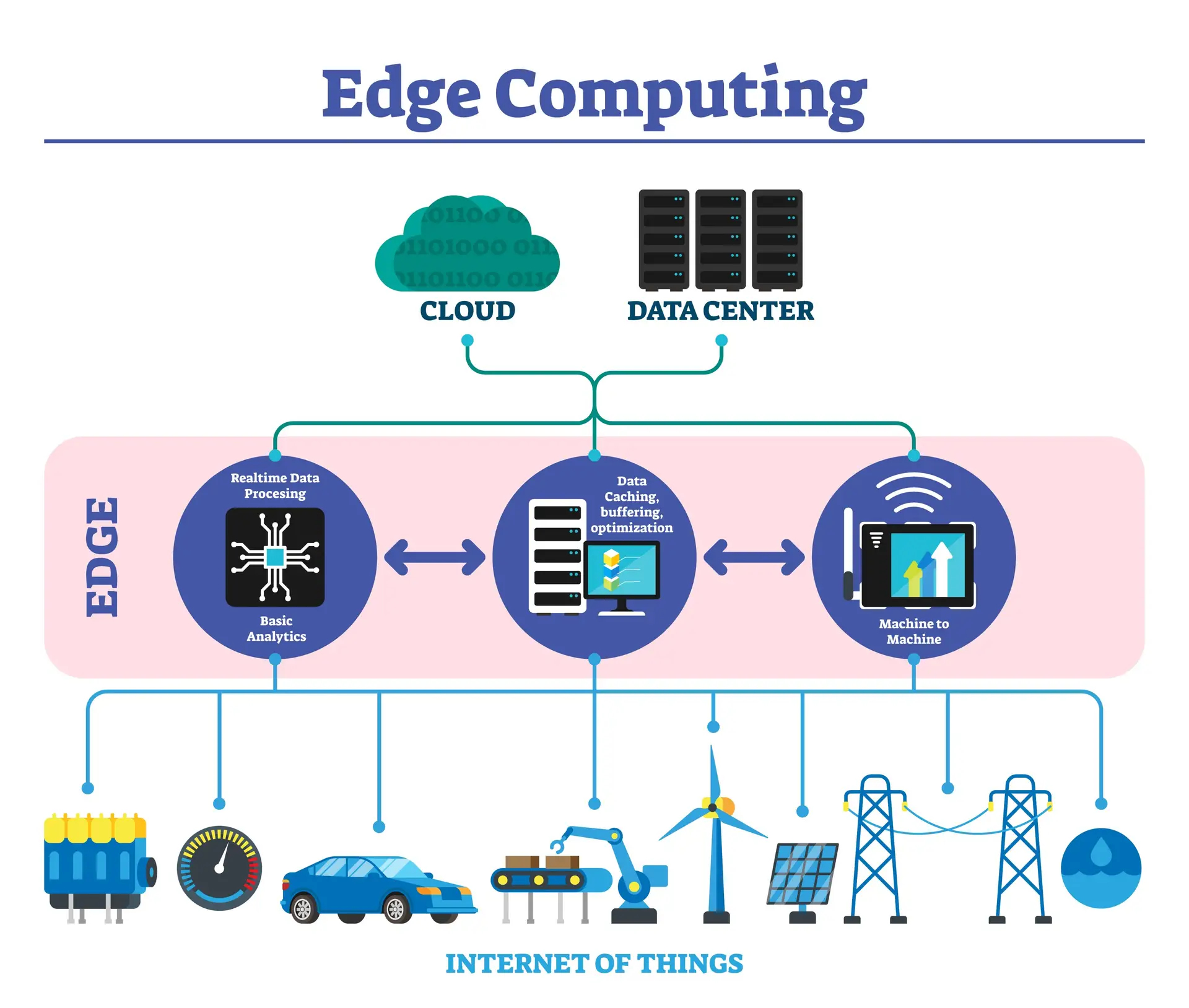
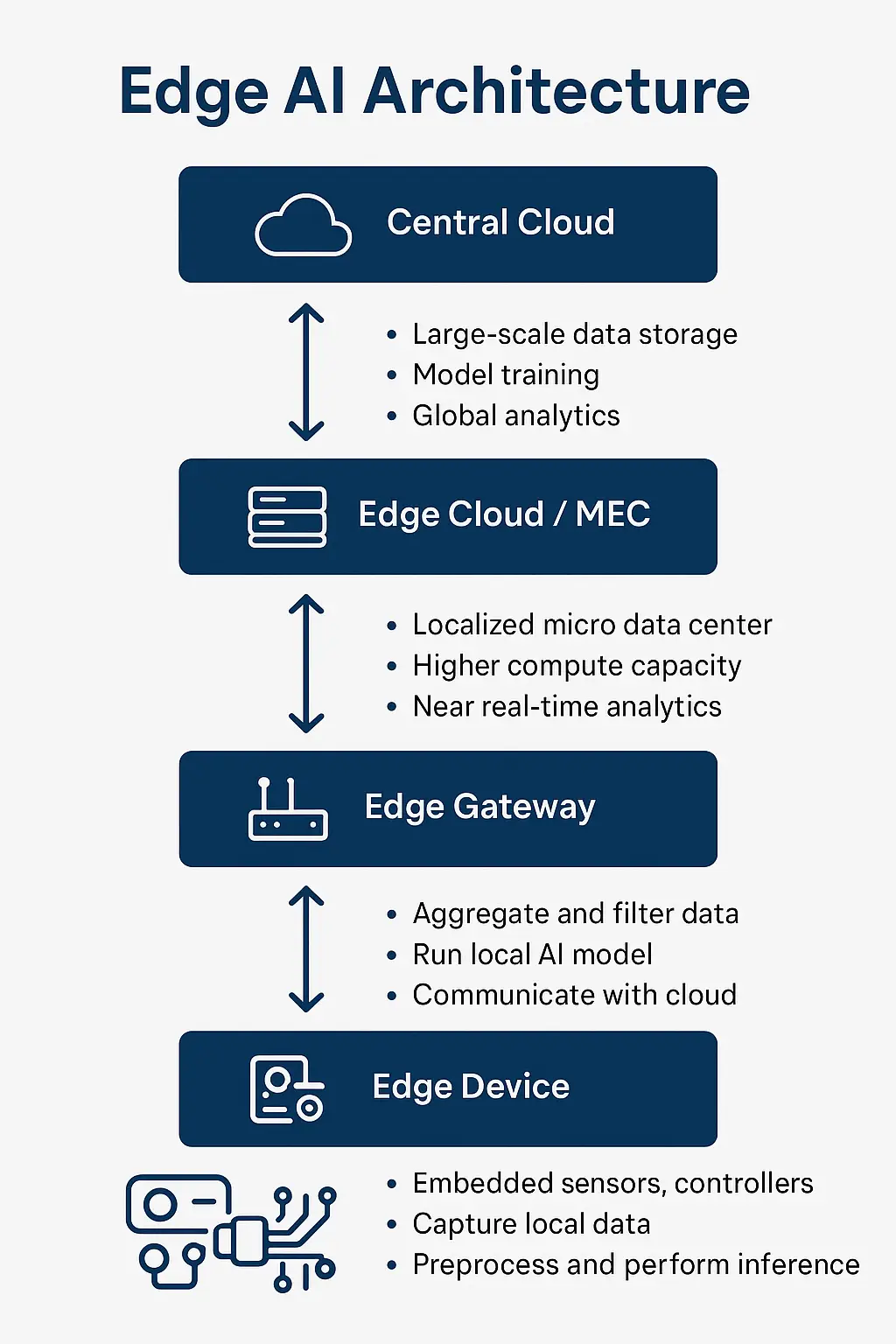
Edge AI typically involves four layers:
- Edge Devices: Embedded sensors, cameras, and controllers that capture raw data (e.g., images, vibrations, audio).
- Edge Gateway: Intermediate processors or micro-servers that aggregate local data and run AI inference or analytics.
- Edge Cloud / MEC (Multi-Access Edge Computing): A localized micro-datacenter providing higher compute capacity for AI workloads near the source.
- Central Cloud: Used for large-scale model training, global analytics, and updates pushed to edge nodes.
Data flow often follows a “train in cloud, infer at edge” model. The cloud trains models using large datasets, compresses or quantizes them, and deploys optimized versions (via ONNX, TensorRT, or TensorFlow Lite) to edge devices.
4. Key Applications Across Industries
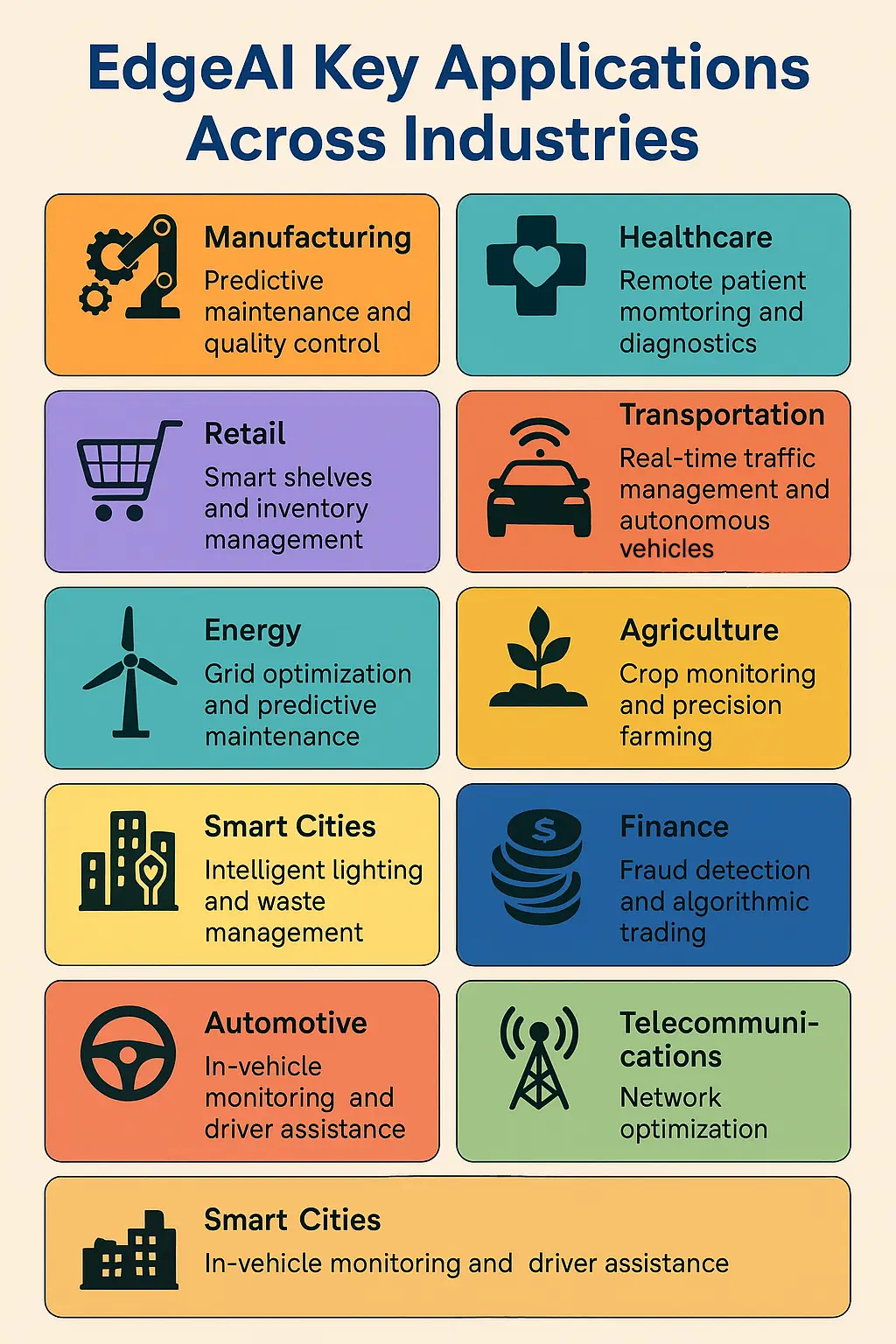
4.1. Industrial Automation (Industry 4.0)
Edge AI monitors machinery health, predicts failures, and optimizes energy consumption. According to Siemens and Deloitte studies, predictive maintenance powered by edge analytics can reduce downtime by 30–50%.
4.2. Healthcare
Wearable biosensors perform on-device ECG or glucose anomaly detection. This reduces cloud dependency, improves patient privacy, and enables continuous health monitoring for remote areas.
4.3. Banking
Edge vision systems assist in real-time customer analytics, queue detection, and fraud prevention — without violating privacy laws.
- Edge fraud detection: Localized AI analyzes transaction patterns instantly.
- ATM monitoring: On-device cameras identify tampering or suspicious behavior.
- Branch automation: Smart kiosks perform customer verification via edge facial recognition.
Edge AI can lower fraud losses by up to 40 % and reduce transaction latency for digital banking (PwC Digital Banking Report, 2024).
4.4. Drones, Aerospace and Robotics
Edge AI enables path planning, obstacle avoidance, and object recognition onboard — critical for defense, logistics, and agricultural applications.
- Autonomous drones: Edge AI enables onboard object recognition, terrain mapping, and navigation.
- Surveillance systems: AI-powered edge processors identify threats in real time.
- Mission analytics: Edge nodes analyze battlefield telemetry without cloud dependency.
4.5. Automobile and mobility
EdgeAI feature in the automobile and mobility industry helps with
- Driver-assist and autonomous systems: Edge AI interprets camera, LiDAR, and radar data for obstacle detection, lane keeping, and collision avoidance.
- Vehicle health monitoring: Embedded models predict engine or battery issues before breakdowns.
- Connected infrastructure: Smart traffic lights and road sensors perform inference locally to adapt signal timing dynamically.
4.6. Smart Cities and Infrastructure
EdgeAI Implemented in city infrastructure helps with
- Intelligent traffic management: Cameras and edge servers count vehicles, detect congestion, optimize signals, detect accidents and alert the emergency response.
- Public safety monitoring: On-device analytics identify unusual activity without sending video to centralized servers.
- Energy and utility grids: Edge AI balances load and predicts outages in distributed power networks.
4.7. Retail and consumer experience
EdgeAI usage in the Retail and consumer experience benefits with
- Smart checkout: Edge cameras and sensors identify products and customers without sending images to the cloud.
- Inventory management: Shelf-edge vision detects stock levels and triggers automatic replenishment.
- Customer analytics: On-premise AI processes behavior data while preserving privacy.
4.8. Energy Oil & Gas
EdgeAI when used in the EO&G industry results with the following list of benefits
- Pipeline monitoring: Edge sensors detect leaks or pressure anomalies using ML models.
- Wind and solar optimization: Local AI predicts output based on weather and performance data.
- Worker safety: Wearable devices detect hazardous exposure or fatigue in remote locations.
4.9. Agriculture and Environmental Monitoring
Agriculture when combined with the EdgeAI gives the benefits below
- Pipeline monitoring: Edge sensors detect leaks or pressure anomalies using ML models.
- Wind and solar optimization: Local AI predicts output based on weather and performance data.
- Worker safety: Wearable devices detect hazardous exposure or fatigue in remote locations.
- Crop Condition: can detect the health of the crop using camera and other sensors inturn sending the reports to farmers, land owners.
4.10. Telecommunications and 5G
With 5G’s rollout, telecom operators are investing heavily in multi-access edge computing (MEC), expected to exceed USD 50 billion by 2028 (GSMA Intelligence, 2024). EdgeAI Benefits in the Telecom sector
- Network optimization: Edge AI predicts congestion and reallocates bandwidth dynamically.
- Edge-enabled content delivery: Local caching reduces latency for streaming and gaming.
- Network security: AI at the edge detects anomalies and mitigates threats closer to the source.
Verizon and Ericsson deploy AI-driven MEC nodes to deliver low-latency AR/VR experiences.
5. Security Challenges at the Edge
Refer to our blog on detailed security challenges faced in EdgeAI by visiting the link below.
6. Economic Impact of Edge AI
According to MarketsandMarkets (2024), the global Edge AI market is valued at USD 28.3 billion in 2024 and is projected to reach USD 166 billion by 2030, growing at a CAGR of 34.5%.
The Asia-Pacific region, led by India, China, and Japan, is expected to witness the fastest adoption, driven by manufacturing, smart cities, and telecommunications.
- In India alone, Edge AI investments are projected to reach USD 4.5 billion by 2030 (Source: Nasscom-AIM report, 2024).
- Globally, Gartner estimates that by 2027, over 55% of enterprise AI models will be deployed at the edge, compared to less than 10% in 2021.
Major companies driving this market include NVIDIA, Qualcomm, Intel, Google, Hailo, and NXP, alongside emerging startups such as SiMa.ai - Scaling Physical AI , Mythic, and Edge Impulse focusing on TinyML and low-power inference.
7. Future Trends and Research Directions
a. Federated and Collaborative Learning
Instead of sending raw data to the cloud, models are trained locally and synchronized through federated learning. Google’s Gboard and healthcare IoT platforms already use this privacy-preserving AI model.
b. TinyML and Ultra-Low-Power AI
TinyML allows deep learning inference on microcontrollers consuming less than 1 mW. This opens the door for AI-powered sensors, agriculture monitors, and edge vision on battery-operated systems.
c. Hardware Innovation
The future of edge computing is hardware-defined. Chips like NVIDIA Jetson Orin Nano, Google Edge TPU, and Qualcomm AI Engine Gen 3 are pushing trillions of operations per second (TOPS) at under 15W, enabling previously impossible real-time inference on small devices.
d. Edge-to-Cloud Continuum
Hybrid architectures will blur the line between edge and cloud, using orchestration frameworks (like Kubernetes at the edge) to dynamically allocate workloads based on latency and power constraints.
8. Challenges Ahead
Despite the momentum, Edge AI faces practical challenges:
- Model optimization trade-offs (accuracy vs size vs latency).
- Heterogeneous hardware ecosystems complicating software portability.
- Limited on-device memory for deep networks.
- Lack of global security standards specific to Edge AI.
Addressing these challenges requires collaboration among semiconductor firms, open-source communities, and regulatory bodies to create trustworthy and interoperable AI edge ecosystems.
9. Conclusion
Edge AI represents the next wave of intelligence distribution — a shift from centralized clouds to ubiquitous, decentralized cognition. Its promise lies not just in faster data processing but in empowering billions of devices to make secure, autonomous decisions in the field.
As the market scales into hundreds of billions of dollars, organizations that invest early in secure, scalable, and sustainable edge infrastructures will lead the next digital revolution.From connected factories to autonomous mobility and beyond, Edge AI is not merely an extension of AI — it’s the new foundation of intelligent infrastructure.
At Aerlync Labs, we support silicon companies and OEMs by bridging hardware potential with system-level deployment. On the embedded engineering side, we bring decades of expertise in real-time operating systems (RTOS), board support packages (BSP), and upstream contributions to Zephyr OS, the fastest-growing open-source RTOS for IoT. Our teams specialize in enabling secure boot processes, integrating connectivity stacks for Wi-Fi, Bluetooth, and Zigbee, and optimizing BSPs for performance and energy efficiency.

Build with the Most Trusted Engineering Partner

Delivers cutting-edge embedded solutions, from firmware development to wireless protocols, ensuring reliability and innovation.

Resources
Copyright © 2026
Privacy Policy
Terms of Service
Delivers cutting-edge embedded solutions, from firmware development to wireless protocols, ensuring reliability and innovation.


Resources
Privacy Policy
Terms of Service
Copyright © 2026