


15 Oct 2025

5 min read
Edge AI: Intelligence at the Frontier of Computing
--Team Aerlync
15 Oct 2025
5 min read
Edge AI: Intelligence at the Frontier of Computing
--Team Aerlync

Edge AI and Secure IoT: Building the Future of Smart and Sustainable Devices
The idea of the “smart home” has undergone a dramatic transformation. Ten years ago, it was easy to dismiss connected lights or Wi-Fi thermostats as novelties—convenient perhaps, but not essential. Today, the story is different. Smart homes are no longer a collection of gadgets waiting for a command; they are evolving into intelligent, context-aware ecosystems capable of anticipating needs, conserving energy, and protecting the people who live in them.
This evolution is being powered by two forces: Edge AI and security by design. Edge AI makes it possible for devices to sense, learn, and respond locally, cutting dependence on the cloud and enabling real-time, privacy-preserving decisions. Security, meanwhile, has shifted from a feature to a necessity, with governments enforcing stricter standards and consumers rewarding companies they trust. Together, these forces are setting the stage for a new generation of silicon innovation—microcontrollers and SoCs that are not only powerful and efficient, but also secure and future-proof against threats like quantum computing.
From Cloud Dependence to Edge Autonomy
For much of the past decade, intelligence in connected devices meant cloud intelligence. Sensors in a camera or smart appliance captured raw data, sent it over the internet, and waited for a response from a server farm often hundreds or thousands of miles away. This architecture worked for scaling computation but exposed fundamental weaknesses: delays that undermined user experience, privacy risks from constant data transfer, and fragility in environments where connectivity could not be guaranteed.
Edge AI has emerged as the solution to these shortcomings. By embedding neural processing units (NPUs) directly inside microcontrollers, device makers can now shift intelligence closer to the source of data. A camera can distinguish between a family member and a potential intruder in milliseconds—without sending a single frame to the cloud. A thermostat can optimize energy use based on patterns of occupancy, not just preprogrammed schedules.
Security and the Age of Regulation
As our homes and workplaces fill with connected devices, security has become the defining challenge of the IoT era. Early adopters quickly learned how fragile the foundations could be. In 2016, the Mirai botnet took advantage of insecure webcams and routers to launch one of the largest distributed denial-of-service (DDoS) attacks in history, temporarily crippling parts of the internet. That incident was a turning point—it showed that a single weak IoT device could be weaponized at scale. Since then, similar attacks on smart doorbells, baby monitors, and even connected cars have underscored the stakes: when every device is a potential entry point, security can no longer be treated as an afterthought.
Governments have responded decisively. The European Union’s Cyber Resilience Act (CRA), which comes fully into force in 2027, requires manufacturers to bake in security from the earliest design stages and maintain it through the entire lifecycle of a device. In the United States, the Cyber Trust Mark is making security visible at the point of sale, giving consumers an easy way to identify devices that meet baseline protections. The UK’s PSTI regulation has already outlawed default passwords and set minimum standards for connected devices. These measures reflect a new reality: compliance is becoming as important as performance for market access.
IOT Security
Securing the Internet of Things: Protecting the Nerves of the Connected World
The Internet of Things (IoT) is transforming our daily lives — connecting smart homes, vehicles, wearables, and city infrastructure into a seamless digital ecosystem. But as billions of devices come online, they also open billions of new doors for cyber threats. From hacked baby monitors to compromised smart grids, the security of IoT devices has become one of the most urgent challenges in modern computing.
What Makes IoT Unique — and Vulnerable
Unlike traditional IT systems, IoT ecosystems combine tiny, resource-constrained devices with cloud platforms and APIs. This creates a perfect storm of complexity:
- Heterogeneous hardware — sensors, gateways, and embedded controllers, each with different firmware and update cycles.
- Lightweight protocols — MQTT, CoAP, Zigbee, or LoRaWAN, which prioritize bandwidth efficiency over strong encryption.
- Massive scale — tens of billions of devices, often deployed in remote or unmanaged locations.
These characteristics make IoT networks agile but fragile — and cyber attackers know it. Compromising one poorly secured device can expose an entire network.
Common IoT Threats and Attack Scenarios
IoT devices are small in form but large in risk. Some of the most common attack types include:
1. Device Hijacking
Attackers exploit weak credentials or outdated firmware to take over IoT devices, turning them into part of a botnet (e.g., the infamous Mirai attack).
2. Data Interception
Unencrypted communication between sensors and servers allows eavesdropping or manipulation of telemetry data, leading to false readings or data theft.
3. Firmware Tampering
Malicious actors modify or inject malware into device firmware to gain persistent control — a threat that’s hard to detect once deployed.
4. API Exploits
IoT platforms often expose APIs for management or analytics. Poorly protected APIs can be exploited to leak sensitive data or control devices remotely.
5. Physical Attacks
IoT nodes deployed in public or industrial environments are vulnerable to tampering, side-channel attacks, or hardware cloning.
Each of these threats exploits a layer of the IoT stack — from the silicon to the cloud.
The Four Pillars of IoT Security
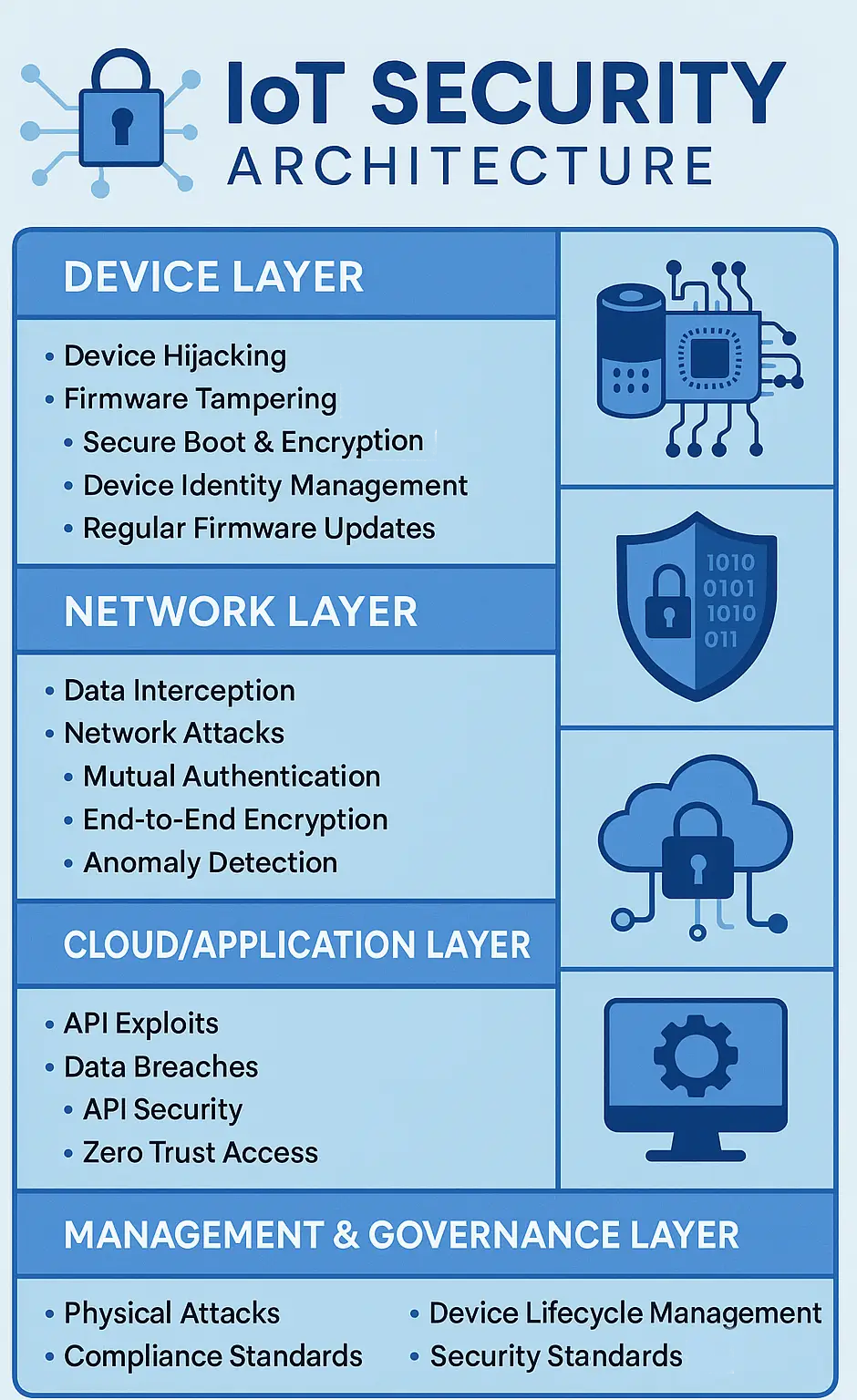
IoT security must be multi-layered, built into every part of the system rather than bolted on later. The following framework outlines the four key layers of defense:
1. Device Layer — Secure the Foundation
- Secure Boot & Hardware Root of Trust: Ensures that only signed firmware can run on a device.
- Encrypted Storage: Protects sensitive keys and configuration data.
- Unique Device Identity: Each device must have a cryptographically verifiable ID.
- Regular Firmware Updates (OTA): Vulnerabilities must be patchable remotely, with authenticity verified using digital signatures.
2. Network Layer — Secure the Communication
- Mutual Authentication between device and server using X.509 certificates or token-based systems.
- End-to-End Encryption with TLS/DTLS to protect MQTT or CoAP messages.
- Segmentation & Firewalls to isolate IoT traffic from enterprise IT networks.
- Anomaly Detection Systems to monitor network behavior and detect compromised devices.
3. Cloud / Application Layer — Secure the Data and APIs
- Zero-Trust Access Control to ensure each device and user has least-privilege permissions.
- Strong API Authentication using OAuth 2.0 or JWT tokens.
- Encrypted Databases to prevent exposure of telemetry or user information.
- Logging & Forensics for continuous auditing and post-incident analysis.
4. Management & Governance Layer — Secure the Lifecycle
- Device Lifecycle Management for provisioning, updates, and decommissioning.
- Compliance Standards like ISO 27001, ETSI EN 303 645, or NISTIR 8259A.
- Security Policy Automation through device management platforms.
- Human Factor Awareness — training operators to recognize and respond to IoT threats.
Modern Security Technologies for IoT
The field of IoT security is rapidly evolving, with emerging technologies offering new layers of protection:
- Trusted Platform Modules (TPM) for key storage and cryptographic operations.
- Hardware Security Modules (HSM) integrated into gateways for key management.
- Blockchain for Device Identity to ensure immutable logs of device registration and firmware changes.
- Edge AI-based Threat Detection that uses local inference to identify abnormal patterns in network behavior.
- Secure Elements & SIM-based Security (eSIM/iSIM) for authentication over cellular IoT.
These solutions bring hardware-grade trust and intelligence to devices that were once considered too constrained for security.
Designing Security into the IoT Lifecycle
Security should begin before the first device is deployed. A well-secured IoT ecosystem follows a continuous cycle:
- Design: Security architecture and threat modeling during development.
- Deploy: Secure onboarding with certificate-based identity.
- Operate: Continuous monitoring and anomaly detection.
- Update: Safe OTA patches for vulnerabilities.
- Decommission: Secure data wipe and key revocation.
This “Secure by Design” philosophy ensures that even low-cost consumer IoT devices maintain baseline resilience throughout their lifetime.
For an in-depth overview, refer to the NIST Edge Computing Security Guidelines (SP 800-207A, 2023).
The Future: Zero Trust for IoT
The Zero Trust model — “never trust, always verify” — is becoming the gold standard for IoT ecosystems. Under Zero Trust:
- Every device must continuously authenticate and authorize before exchanging data.
- Every connection is encrypted and logged.
- Every anomaly triggers automated isolation before escalation.
Combined with AI-driven threat intelligence, Zero Trust can adapt dynamically to evolving attack patterns, enabling self-healing IoT networks.
Trust as the True Enabler of IoT
The promise of IoT — smarter cities, efficient industries, and connected living — can only be realized through secure connectivity. As devices become the “nerves” of our digital world, protecting them is as vital as protecting the human nervous system itself.
A secure IoT network isn’t just about firewalls or passwords; it’s about end-to-end integrity, accountability, and resilience. By embedding security into every device, protocol, and process, we ensure that innovation at the edge remains trusted, scalable, and sustainable.
Edge AI Security
Edge AI / Edge Computing
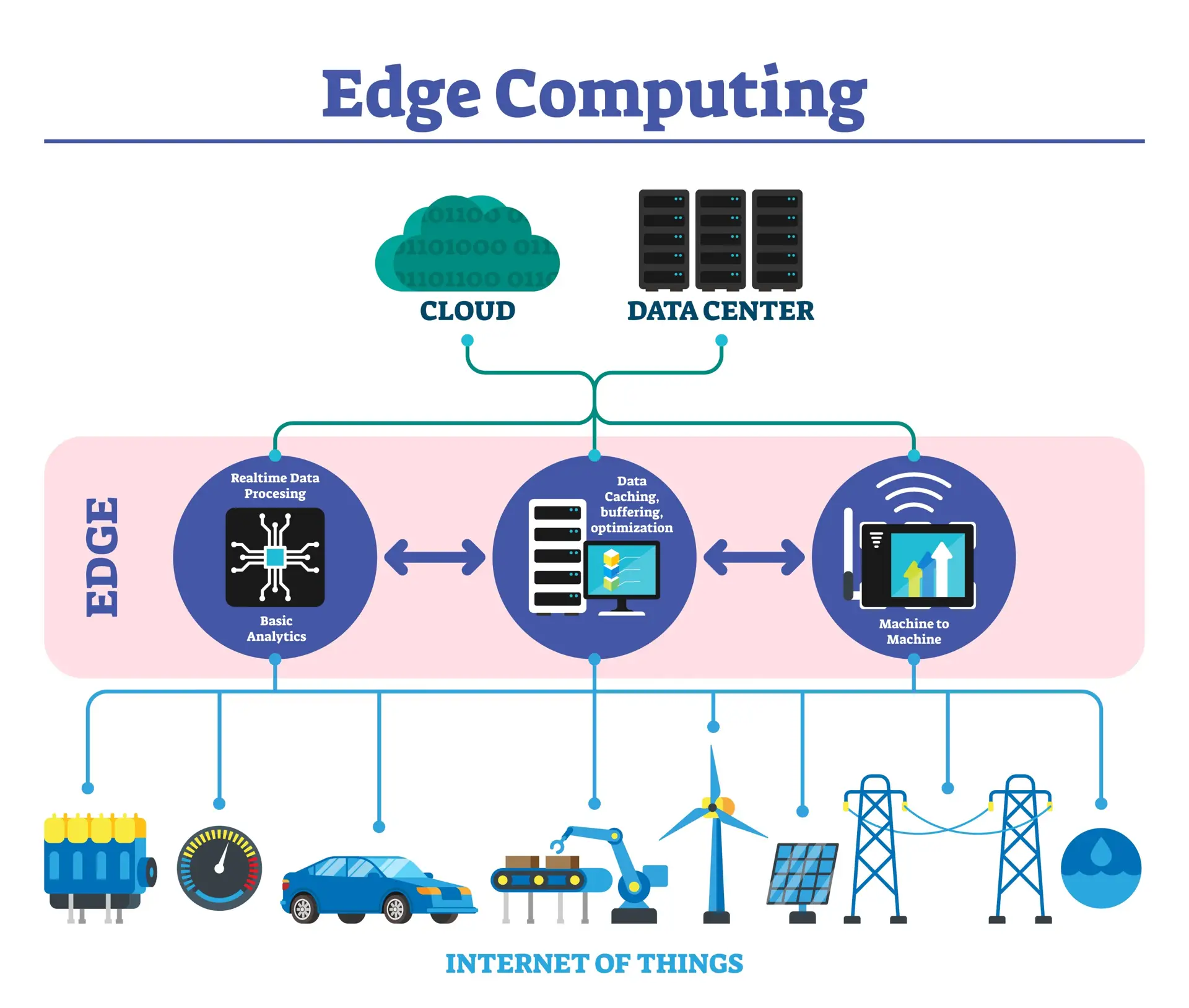
Securing Intelligence at the Edge: The Future of Edge AI Security
Artificial Intelligence is no longer confined to the cloud. With the rise of Edge AI, smart devices—from surveillance cameras to autonomous drones and industrial sensors—can now process data locally, make real-time decisions, and operate with minimal dependence on centralized servers. This transformation drastically improves latency, privacy, and efficiency, but it also introduces new vulnerabilities.
The Expanding Edge Ecosystem
Edge AI systems sit at the intersection of hardware, connectivity, and machine learning. They consist of three key layers:
- Edge Device Layer: Smart endpoints such as sensors, cameras, wearables, or embedded AI modules that collect and process raw data.
- Edge Gateway Layer: Local processing nodes that handle inference aggregation, temporary storage, and secure connectivity to the cloud.
- Cloud Layer: Centralized infrastructure for large-scale model training, federated learning coordination, and global analytics.
While this distributed design enhances scalability and autonomy, it also means each layer becomes a potential attack surface. Threats can move horizontally (between edge devices) or vertically (from device to cloud and back).
Common Attack Vectors in Edge AI
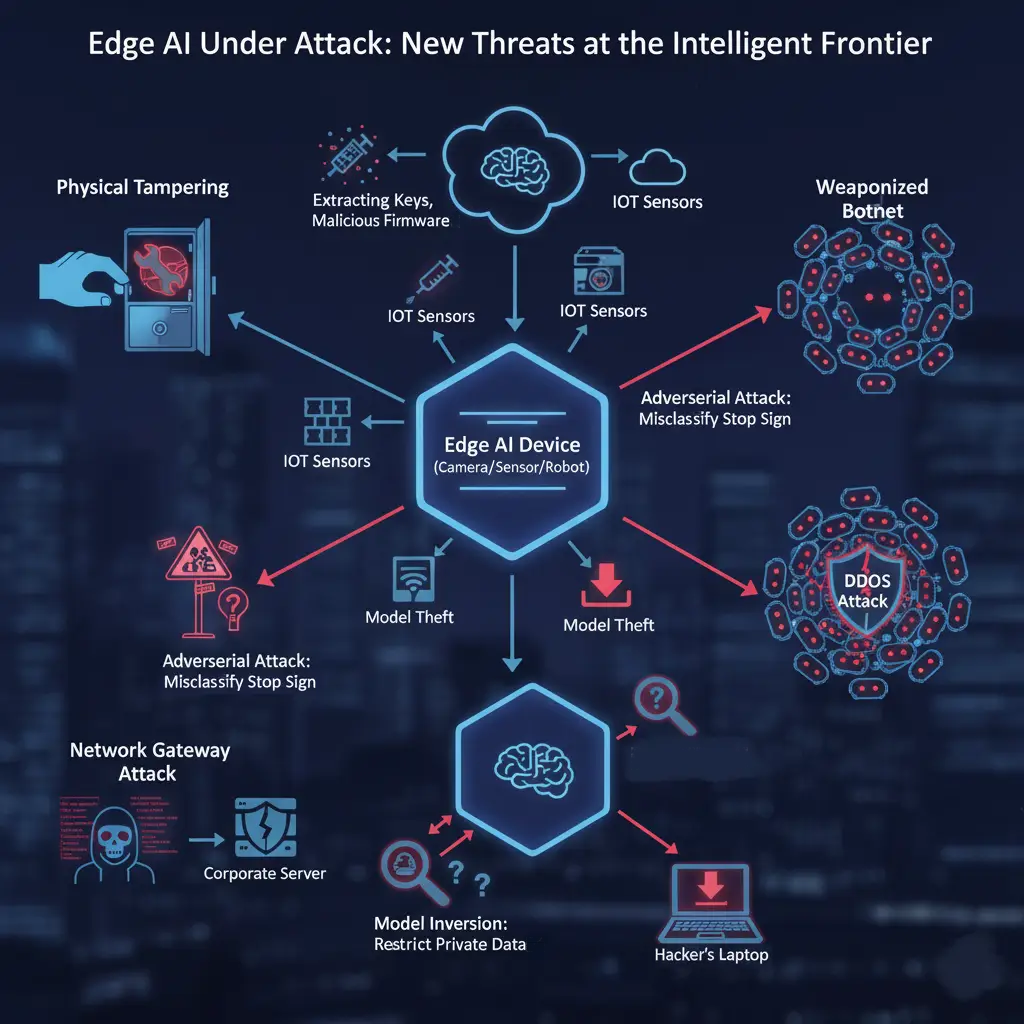
The Edge AI Security Architecture diagram visualizes how attacks propagate through this layered structure. Some of the most prominent threats include:
1. Data Poisoning
Attackers manipulate the training or inference data at the device level—feeding corrupted inputs that bias the AI model’s decision-making. For instance, a compromised sensor in a smart factory could inject false readings to trigger unnecessary maintenance cycles.
2. Adversarial Inputs
Maliciously crafted inputs—like slightly altered images or signals—can trick deep learning models into misclassification. In autonomous vehicles, this could cause a stop sign to be misread as a speed limit, leading to catastrophic results.
3. Model Inversion and Extraction
At the gateway or cloud layer, attackers may reverse-engineer model parameters or extract sensitive information about training data, effectively stealing intellectual property or violating privacy.
4. Communication Channel Attacks
Without strong encryption and authentication, the data exchanged between edge and cloud can be intercepted or modified, resulting in model corruption, data leaks, or system hijacking.
5. Physical Tampering
Physical tampering refers to any unauthorized physical access or manipulation of Edge AI hardware, sensors, or storage components. Unlike cloud systems, edge devices (such as gateways, smart cameras, autonomous drones, or factory AI modules) are deployed in unprotected environments — roadsides, retail stores, warehouses, or industrial plants — making them prime targets for attackers.
Multi-Layered Defense Strategies
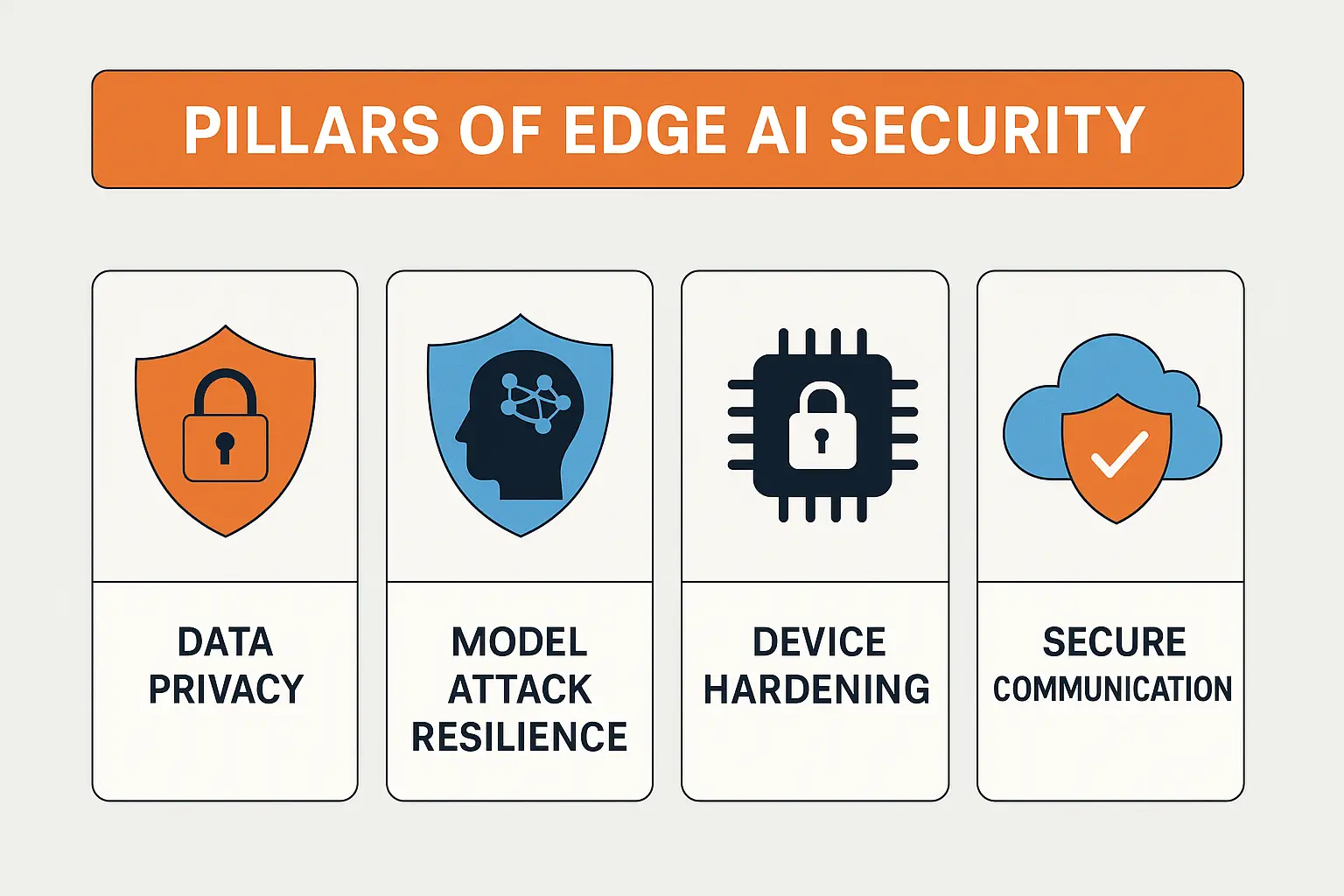
To build a resilient Edge AI system, security must be embedded by design—not added as an afterthought. Each layer requires its own specialized defenses:
Device Layer: Hardware Root of Trust
- Secure Boot & Trusted Execution Environments (TEE): ensure only verified firmware and models run on the device.
- On-Device Encryption: safeguards sensitive data in RAM and non-volatile storage.
- Model Integrity Verification: detects unauthorized changes to deployed models.
Gateway Layer: Secure Data Flow
- Mutual Authentication between devices and gateways using certificates or secure elements.
- Differential Privacy to anonymize local inference results before transmission.
- Edge Firewalls and Intrusion Detection Systems that monitor unusual network behavior.
Cloud Layer: Secure Collaboration
- Federated Learning Validation Pipelines: prevent poisoned model updates from compromising global models.
- Anomaly Detection Systems: continuously monitor for performance drift or abnormal gradient updates.
- Encrypted Model Repositories: with role-based access control for developers and operators.
By coordinating these protections, organizations can achieve end-to-end trust—from sensor to cloud—ensuring that data integrity and model reliability remain uncompromised.
Emerging Technologies Strengthening Edge AI Security
Several modern technologies are reshaping how we secure distributed AI ecosystems:
- Homomorphic Encryption: enables computations on encrypted data, reducing the need for raw data exposure.
- Blockchain-based Identity Management: allows devices to authenticate each other without a central authority.
- Secure Enclaves (e.g., Intel SGX, ARM TrustZone): isolate critical AI workloads from the rest of the system.
- AI-Driven Threat Detection: uses machine learning to detect anomalies or intrusions faster than traditional rule-based systems.
These approaches shift the paradigm from reactive security (detect and respond) to proactive security (predict and prevent).
Designing for Security and Performance
While security is critical, it must not come at the expense of speed and energy efficiency—both vital for edge devices. Therefore, design teams must adopt “security-performance co-optimization” practices:
- Deploy lightweight encryption algorithms optimized for microcontrollers.
- Use quantized or compressed models to reduce attack surface and computational overhead.
- Implement runtime monitoring that can flag suspicious inference patterns without heavy CPU load.
The goal is to make every edge node self-defensive yet efficient—secure intelligence without bottlenecks.
Trust Is the New Edge
As AI continues to decentralize, trust becomes the new perimeter. Traditional cloud-centric firewalls no longer suffice; instead, every node in the network must become self-aware, authenticated, and resilient.
The integration of secure enclaves, encrypted communication, and federated learning validation ensures that even if one edge node is compromised, the broader ecosystem remains protected.
In short, Edge AI security is not just about protecting models—it’s about preserving the integrity of decisions made by machines that think for us. The future of Edge AI belongs to those who can make intelligence not only fast and local but also safe and trustworthy.
Post-Quantum Cryptography: Preparing for the Next Threat
While regulatory pressure focuses attention on today’s vulnerabilities, another challenge is already looming. The cryptography that underpins nearly all digital security—RSA, elliptic curve cryptography, Diffie–Hellman—depends on mathematical problems that are prohibitively difficult for classical computers to solve. However, with the advent of quantum computing, that assumption no longer holds. Shor’s algorithm, first proposed in the 1990s, showed that a sufficiently powerful quantum computer could break RSA and ECC in a fraction of the time, rendering current encryption useless.
Although practical, large-scale quantum computers are still years away, the danger lies in what security experts call “harvest now, decrypt later.” Sensitive communications encrypted today may be intercepted and stored by adversaries, waiting for the day quantum machines can decrypt them. For long-lived devices—smart meters, industrial sensors, medical implants, and automotive controllers—that future could arrive while the product is still in use.
To address this, the U.S. National Institute of Standards and Technology (NIST) has finalized the first post-quantum cryptography standards, including FIPS 203 (ML-KEM) for key exchange and ML-DSA for digital signatures. Europe, the UK, and China are aligning with their own strategies, and multinational corporations are beginning pilot programs. The message is clear: devices must be future-proof by design, not retrofitted later. A recall to patch millions of IoT devices with PQC-ready firmware after deployment would be financially devastating and logistically impossible.
Engineering at the Edge: Performance Meets Security
Beyond compliance and PQC readiness, the success of future devices depends on engineering excellence at the edge. Consumers expect more intelligence, more responsiveness, and longer battery life, all without sacrificing trust. Meeting these demands requires a holistic approach that combines high-performance embedded software with rigorous security practices.
At Aerlync Labs, we support silicon companies and OEMs by bridging hardware potential with system-level deployment. On the embedded engineering side, we bring decades of expertise in real-time operating systems (RTOS), board support packages (BSP), and upstream contributions to Zephyr OS, the fastest-growing open-source RTOS for IoT. Our teams specialize in enabling secure boot processes, integrating connectivity stacks for Wi-Fi, Bluetooth, and Zigbee, and optimizing BSPs for performance and energy efficiency.
On the security side, we provide a comprehensive suite of services designed to strengthen trust from design to deployment. This includes penetration testing to uncover vulnerabilities, security audits to ensure compliance with emerging regulations, and consulting engagements to help OEMs and silicon vendors integrate security by design into their roadmaps. For clients seeking to differentiate in regulated markets like healthcare or automotive, we also assist with alignment to functional safety standards such as MISRA and ISO 26262.
Conclusion: Securing the Edge in an AI-Driven World
The next decade of connected devices will be defined not just by their intelligence, but by the trust they inspire. As AI pushes deeper into our homes, vehicles, factories, and hospitals, the stakes rise with it. Edge AI is becoming the architecture of choice—delivering low-latency inference, privacy-preserving design, and resilience when cloud connectivity falters. But the same compute capability that makes devices smarter also expands their attack surface, making security the foundation on which the future must be built.
The growing footprint of AI in IoT is undeniable: from doorbells that analyze video locally, to wearables that interpret health signals in real time, to industrial controllers making predictive decisions at the edge. Each of these applications depends on silicon that is efficient, scalable, and hardened against both today’s cyberthreats and tomorrow’s quantum risks. Post-quantum cryptography is not a distant theoretical problem; it is a near-term requirement for devices that will remain in service for a decade or more.
For silicon vendors and OEMs, the message is clear: architect for security and compute together. NPUs integrated into MCUs, secure boot, crypto-agility, hardware roots of trust, and interoperable standards like Matter must converge into holistic platforms. Performance without security will not survive regulatory scrutiny; security without compute will not satisfy consumer expectations for intelligence.
At Aerlync Labs, we stand at this intersection. We partner with leading silicon innovators to bring secure architectures, advanced Edge AI compute, and rigorous security engineering into harmony. Our mission is to ensure that the connected world grows not only smarter, but also safer—and that every device, from the smallest sensor to the most complex edge system, is designed to withstand the challenges of an AI-driven future.


Build with the Most Trusted Engineering Partner

Delivers cutting-edge embedded solutions, from firmware development to wireless protocols, ensuring reliability and innovation.

Resources
Copyright © 2026
Privacy Policy
Terms of Service
Delivers cutting-edge embedded solutions, from firmware development to wireless protocols, ensuring reliability and innovation.


Resources
Privacy Policy
Terms of Service
Copyright © 2026