


17 Jun 2026

5 min read
Beyond Cables: The Next Era of Industrial Wireless Connectivity
-Aerlync Team
17 Jun 2026
5 min read
Beyond Cables: The Next Era of Industrial Wireless Connectivity
-Aerlync Team
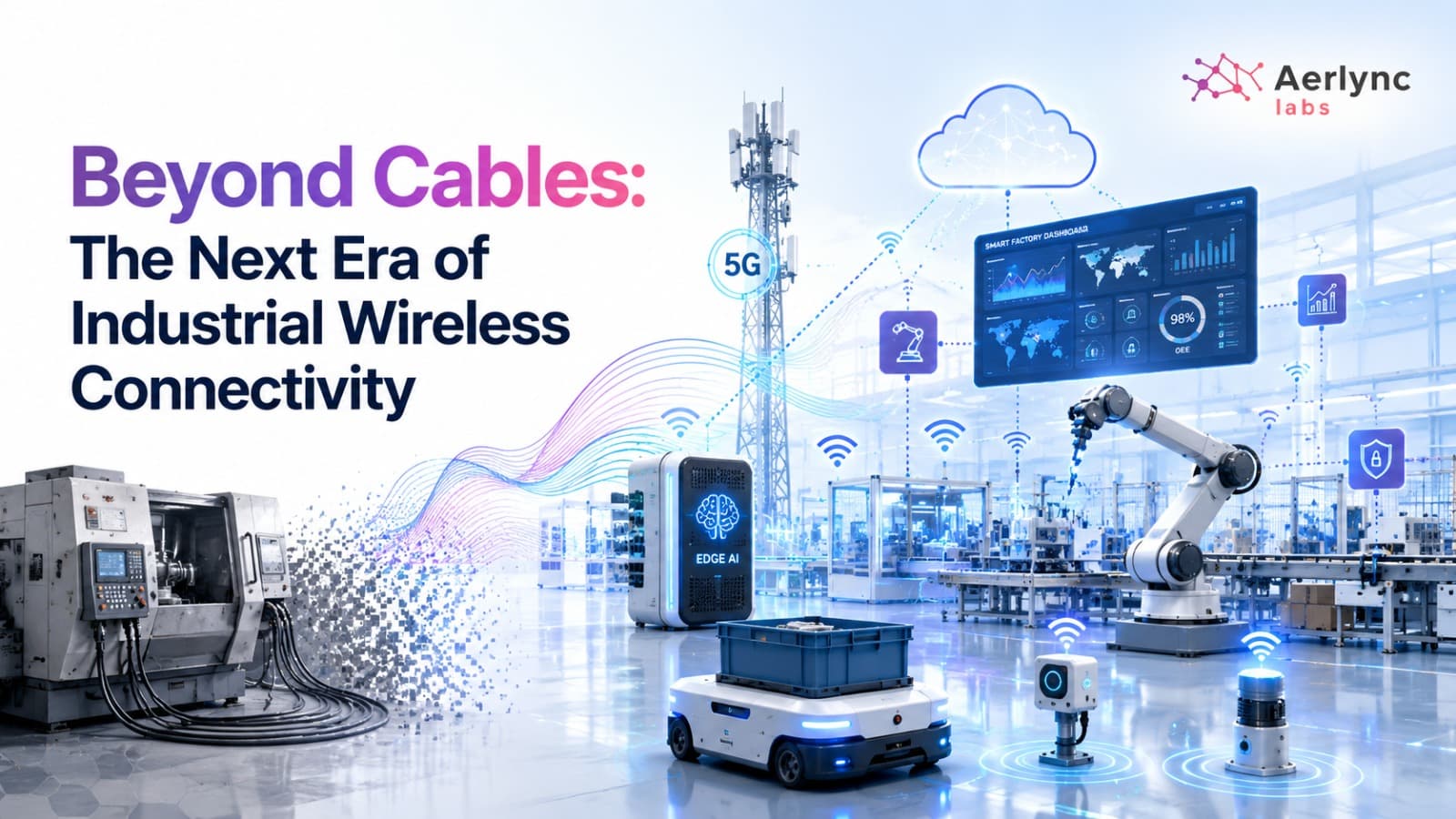
Industrial products are undergoing a profound transformation.
Machines that once operated independently are now expected to communicate seamlessly, exchange real-time data, support remote operations, and contribute to intelligent decision-making across entire industrial ecosystems.
As Industry continues to accelerate, wireless connectivity is no longer a convenience—it has become a strategic enabler of innovation. From smart factories and connected supply chains to autonomous mobile robots and predictive maintenance systems, wireless technologies are reshaping how industrial products are designed, deployed, and managed.
The question is no longer whether industrial products should be connected. The question is how organizations can build scalable, secure, and future-ready connectivity architectures that support the next generation of industrial innovation.
Why Industrial Connectivity Is Reaching a Turning Point
The industrial sector is experiencing unprecedented growth in connected devices and machine-generated data.
According to industry forecasts, the number of connected IoT devices worldwide is expected to grow from approximately 19.8 billion in 2025 to more than 40 billion by 2034. At the same time, manufacturers are investing heavily in smart factories, industrial automation, digital twins, and edge computing technologies.
This growth is creating a fundamental shift in industrial product development.
Modern industrial equipment is expected to:
- Enable real-time monitoring
- Support remote diagnostics
- Integrate with cloud platforms
- Deliver predictive maintenance insights
- Communicate across multiple systems and networks
As a result, wireless connectivity is becoming the backbone of connected industrial ecosystems.
Organizations searching for future-ready wireless connectivity solutions for industrial products are increasingly realizing that connectivity is no longer a standalone feature—it is a core component of product performance, scalability, and competitiveness.
The Wireless Technologies Driving Industrial Innovation
The future of industrial connectivity will not be defined by a single technology. Instead, manufacturers will adopt a combination of wireless solutions based on specific operational requirements.
Private 5G Networks
Private 5G is rapidly emerging as a game-changing technology for industrial environments.
Unlike public cellular networks, private 5G networks provide dedicated connectivity, greater control, enhanced security, and ultra-low latency performance.
Key applications include:
- Autonomous Mobile Robots (AMRs)
- Automated Guided Vehicles (AGVs)
- Smart warehouses
- Industrial robotics
- Real-time process monitoring
For organizations seeking low-latency wireless connectivity for industrial automation, private 5G is becoming a compelling solution.
Wi-Fi 6E and Wi-Fi 7
While 5G attracts significant attention, Wi-Fi remains a critical technology in industrial environments.
Wi-Fi 6E and the emerging Wi-Fi 7 standard offer:
- Higher throughput
- Reduced network congestion
- Improved device density
- Better reliability in demanding environments
As factories become increasingly connected, Wi-Fi continues to play a central role in enabling industrial IoT connectivity.
Bluetooth Low Energy (BLE)
Bluetooth Low Energy remains highly effective for:
- Asset tracking
- Sensor connectivity
- Equipment monitoring
- Worker safety systems
Its low power consumption makes it ideal for battery-operated industrial devices.
The Rise of Private 5G Networks
Among all emerging technologies, private 5G is attracting the greatest attention from industrial leaders.
Manufacturers increasingly require networks capable of supporting:
- Massive device connectivity
- Real-time control systems
- Mobile robotics
- Autonomous operations
- Mission-critical applications
Traditional wireless solutions often struggle to meet these requirements consistently.
Private 5G addresses these challenges by delivering:
- Ultra-reliable connectivity
- Deterministic performance
- Enhanced cybersecurity
- Network segmentation
- Greater operational control
Industry analysts project substantial growth in private 5G deployments over the next decade as industrial organizations continue their digital transformation journeys.
For many organizations, private 5G is becoming the foundation for future smart factory initiatives.
Why Wi-Fi Remains Essential to Industrial Connectivity
Despite the excitement surrounding private 5G, Wi-Fi continues to evolve at an impressive pace.
The introduction of Wi-Fi 7 is expected to bring significant improvements in:
- Throughput
- Latency
- Reliability
- Spectrum utilization
For industrial environments, these advancements create new opportunities for connected equipment, machine vision systems, and real-time analytics.
A choice between Wi-Fi and 5G will not define the future industrial environment.
Instead, successful organizations will build hybrid connectivity architectures that leverage the strengths of both technologies.
This trend is becoming increasingly important for companies exploring industrial wireless networking solutions for smart factories.
Edge AI Is Reshaping Connectivity Requirements
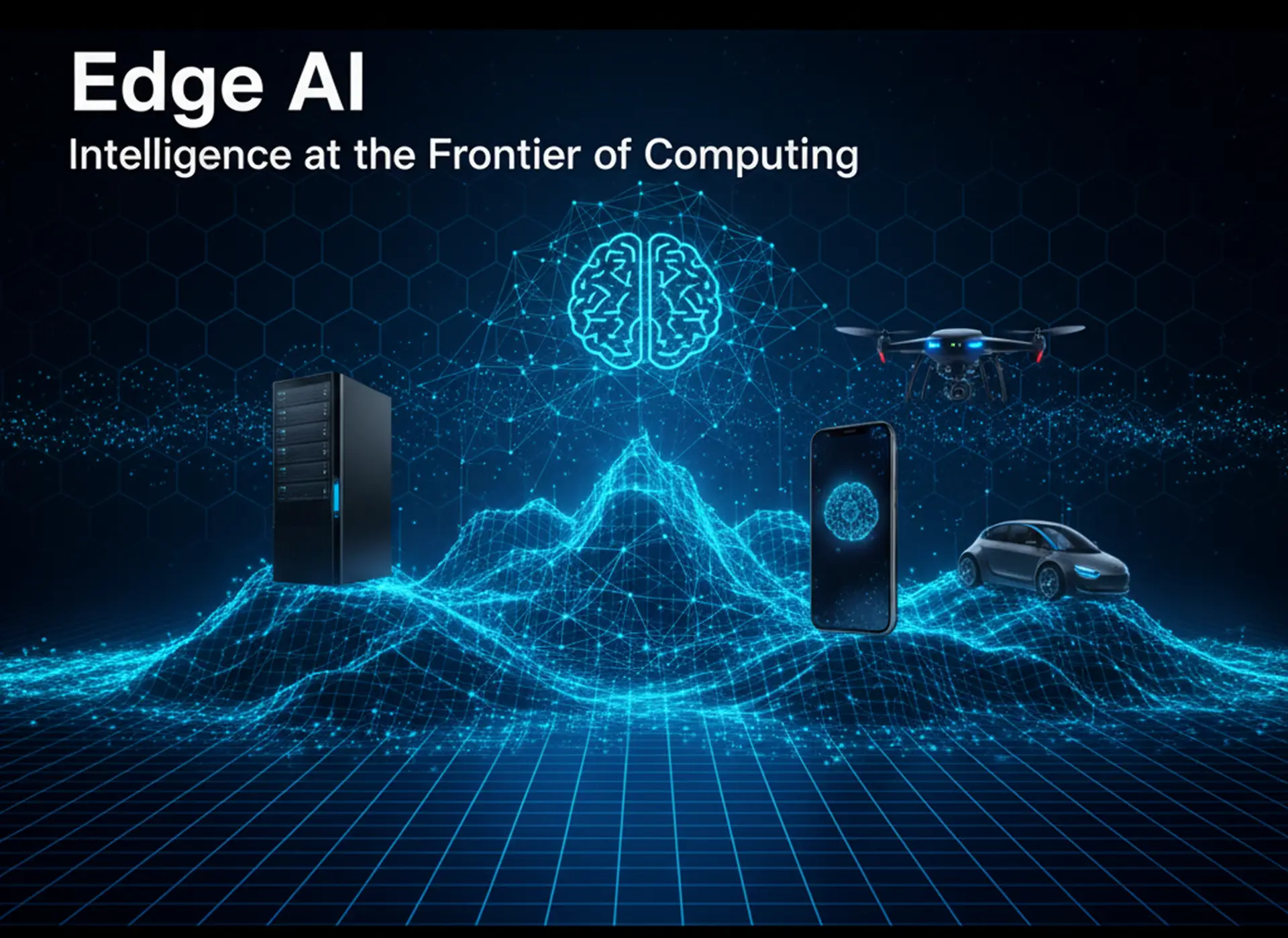
One of the most significant developments in 2026 is the rapid convergence of wireless connectivity and Edge AI.
Industrial products are becoming smarter.
Rather than sending all data to centralized cloud systems, modern devices increasingly process information locally and make decisions at the edge. Examples include:
- Predictive maintenance systems
- Intelligent cameras
- Autonomous robots
- Quality inspection systems
- Industrial safety platforms
This shift is changing what organizations expect from wireless networks. Future industrial connectivity solutions must support:
- Low latency
- High reliability
- Real-time communication
- Secure data transmission
- AI-driven decision-making
In many ways, wireless networks are evolving from data transport systems into platforms that enable distributed intelligence.
Emerging Trends Shaping the Next Decade
Several trends are expected to define the future of wireless connectivity in industrial products.
AI-Optimized Networks
Artificial intelligence will increasingly be used to optimize network performance, improve reliability, and automate connectivity management.
Digital Twin Integration
Wireless connectivity will serve as the critical link between physical assets and digital twin environments.
Industrial Edge Computing
Processing data closer to machines will reduce latency and improve operational efficiency.
Multi-Protocol Connectivity Ecosystems
Future industrial products will support multiple wireless technologies simultaneously to maximize flexibility and resilience.
Future Industry
The next phase of industrial transformation will emphasize collaboration among humans, machines, and intelligent systems, creating new demands for connectivity.
Challenges That Cannot Be Ignored
While opportunities are significant, organizations must address several critical challenges. These include:
- Cybersecurity risks
- Network interoperability
- Legacy infrastructure integration
- Spectrum management
- Reliability in harsh industrial environments
- Managing large-scale device deployments
As wireless connectivity becomes more central to industrial operations, security and resilience must be engineered into products from the beginning rather than added later.
Organizations investing in secure wireless connectivity for industrial IoT devices will be better positioned to scale their operations and reduce long-term risk.
To Sum It All Up…
Historically, industrial products were differentiated by mechanical performance, durability, or production efficiency.
That reality is changing.
The next generation of industrial products will increasingly be judged by how effectively they connect, communicate, and collaborate within broader digital ecosystems.
Wireless connectivity is no longer simply an enabling technology. It is becoming a competitive advantage.
Organizations that successfully integrate embedded systems, wireless networking, edge intelligence, cloud connectivity, and cybersecurity into a unified architecture will be better positioned to accelerate innovation and deliver greater value to customers.
The future belongs to products that are not only connected—but intelligently connected.
Final Thoughts
The future of wireless connectivity in industrial products extends far beyond faster networks or greater bandwidth.
It is about enabling smarter operations, autonomous decision-making, predictive insights, and seamless collaboration across industrial ecosystems.
As technologies such as Private 5G, Wi-Fi 7, Edge AI, Industrial IoT, and digital twins continue to mature, wireless connectivity will become one of the most important foundations of industrial innovation.
Organizations that invest today in scalable, secure, and intelligent connectivity architectures will be better prepared to lead the next generation of smart manufacturing, connected infrastructure, and industrial transformation.
In the years ahead, the most successful industrial products will not simply perform tasks.
They will communicate, learn, adapt, and collaborate.

Build with the Most Trusted Engineering Partner

Delivers cutting-edge embedded solutions, from firmware development to wireless protocols, ensuring reliability and innovation.

Resources
Copyright © 2026
Privacy Policy
Terms of Service
Delivers cutting-edge embedded solutions, from firmware development to wireless protocols, ensuring reliability and innovation.


Resources
Privacy Policy
Terms of Service
Copyright © 2026