


16 Apr 2026

5 min read
The ath12k Unified Driver Model
-Team Aerlync
16 Apr 2026
5 min read
The ath12k Unified Driver Model
-Team Aerlync

How Qualcomm is rearchitecting Wi-Fi for the Linux kernel — turning a generation-specific driver into a living platform for all future Qualcomm wireless silicon.
The Problem
A History Lesson Written in C
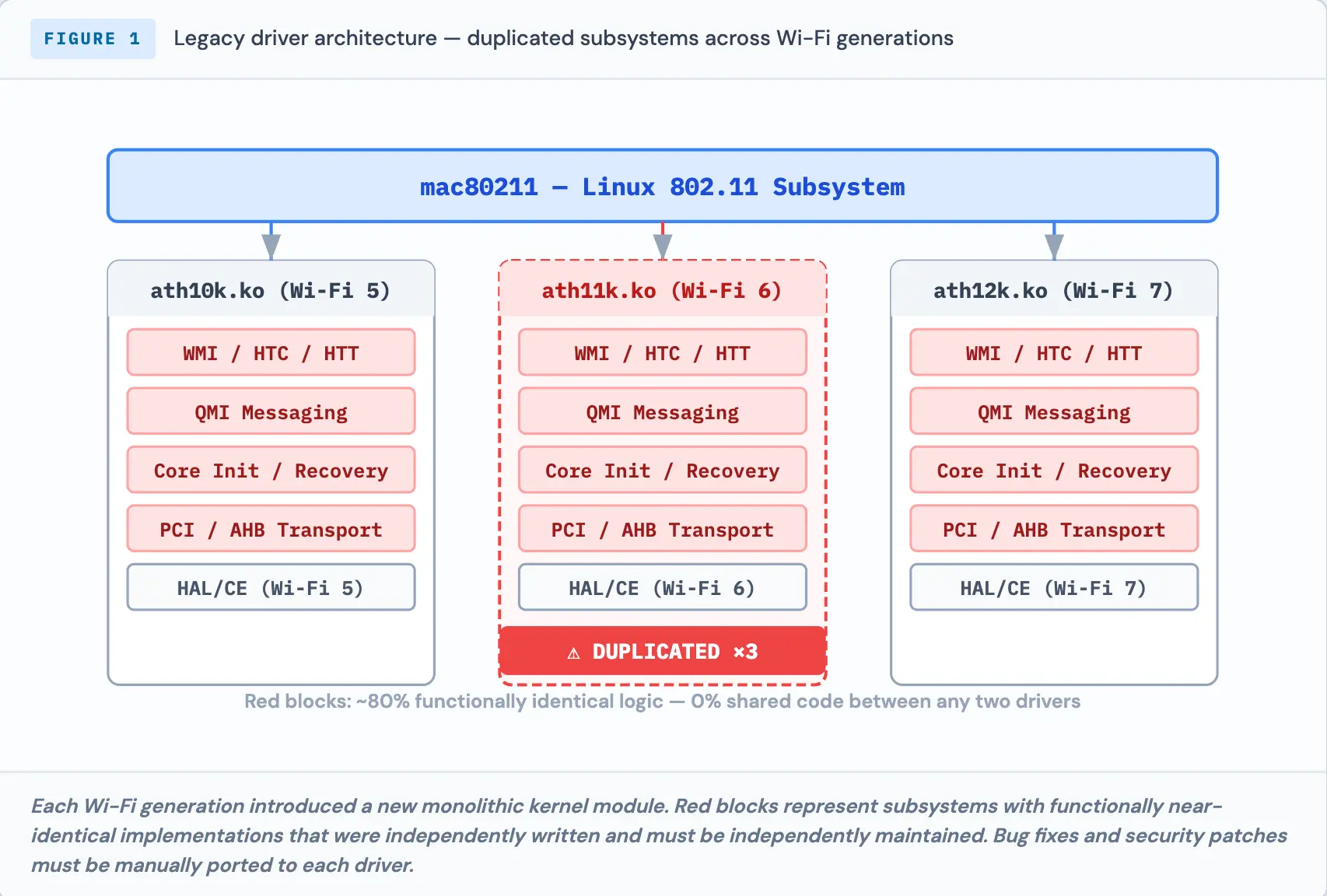
Open any recent Linux kernel tree and navigate to drivers/net/wireless/ath/. What you find is a generational timeline: ath9k for 802.11n, ath10k for Wi-Fi 5, ath11k for Wi-Fi 6, ath12k for Wi-Fi 7 — each a complete, self-contained driver, each solving the same problems its predecessor already solved.
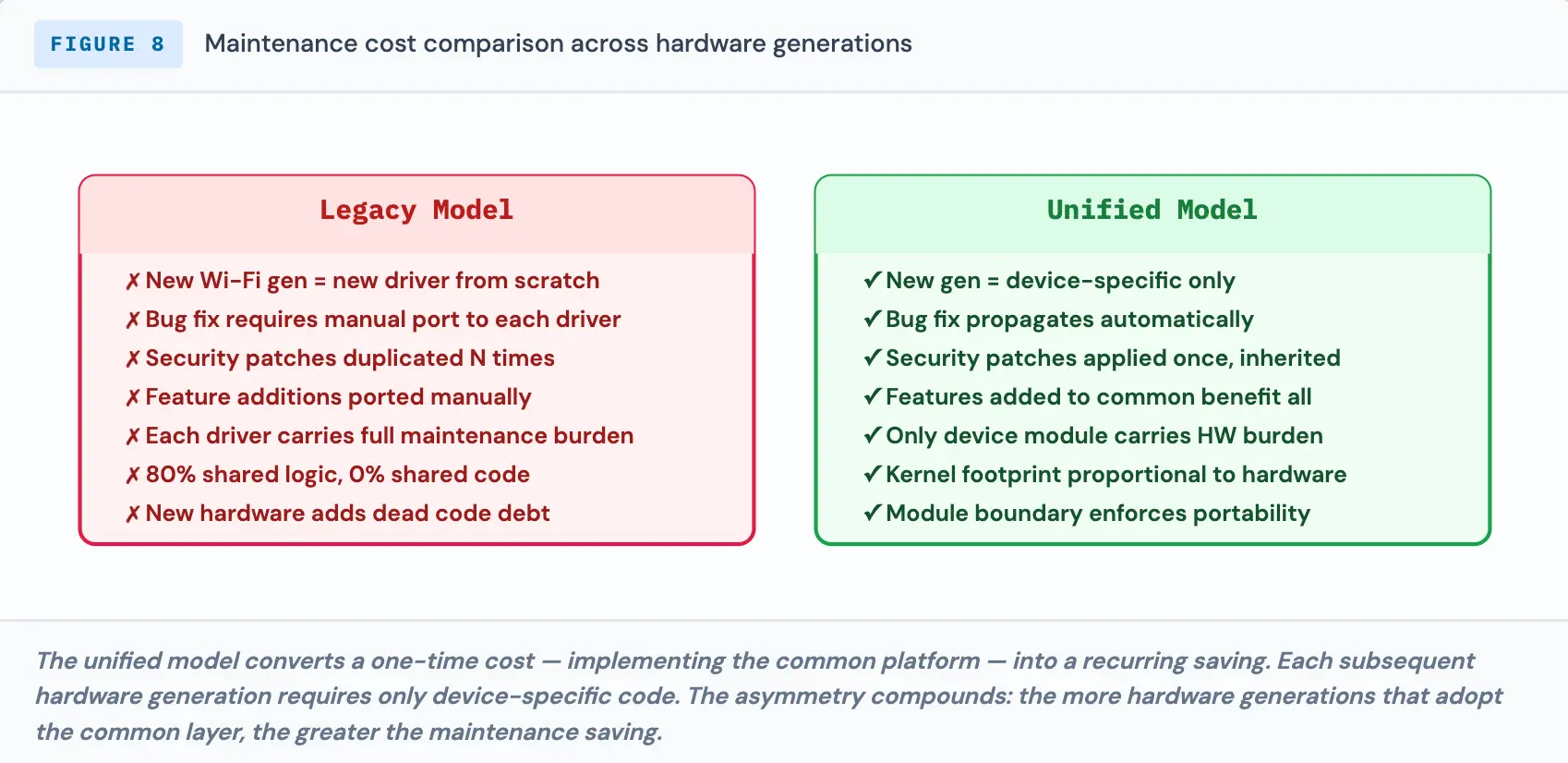
This is the silent tax of generational hardware refreshes. ath10k and ath11k share an estimated 80% of their functional logic — identical WMI messaging model, identical HTC/HTT framing, identical firmware recovery philosophy — but share exactly zero lines of code. Every bug fix, every security patch, every protocol corner case must be manually evaluated and ported. The ath12k unified driver model is the attempt to break this cycle.
The Three-Tier Portability Model
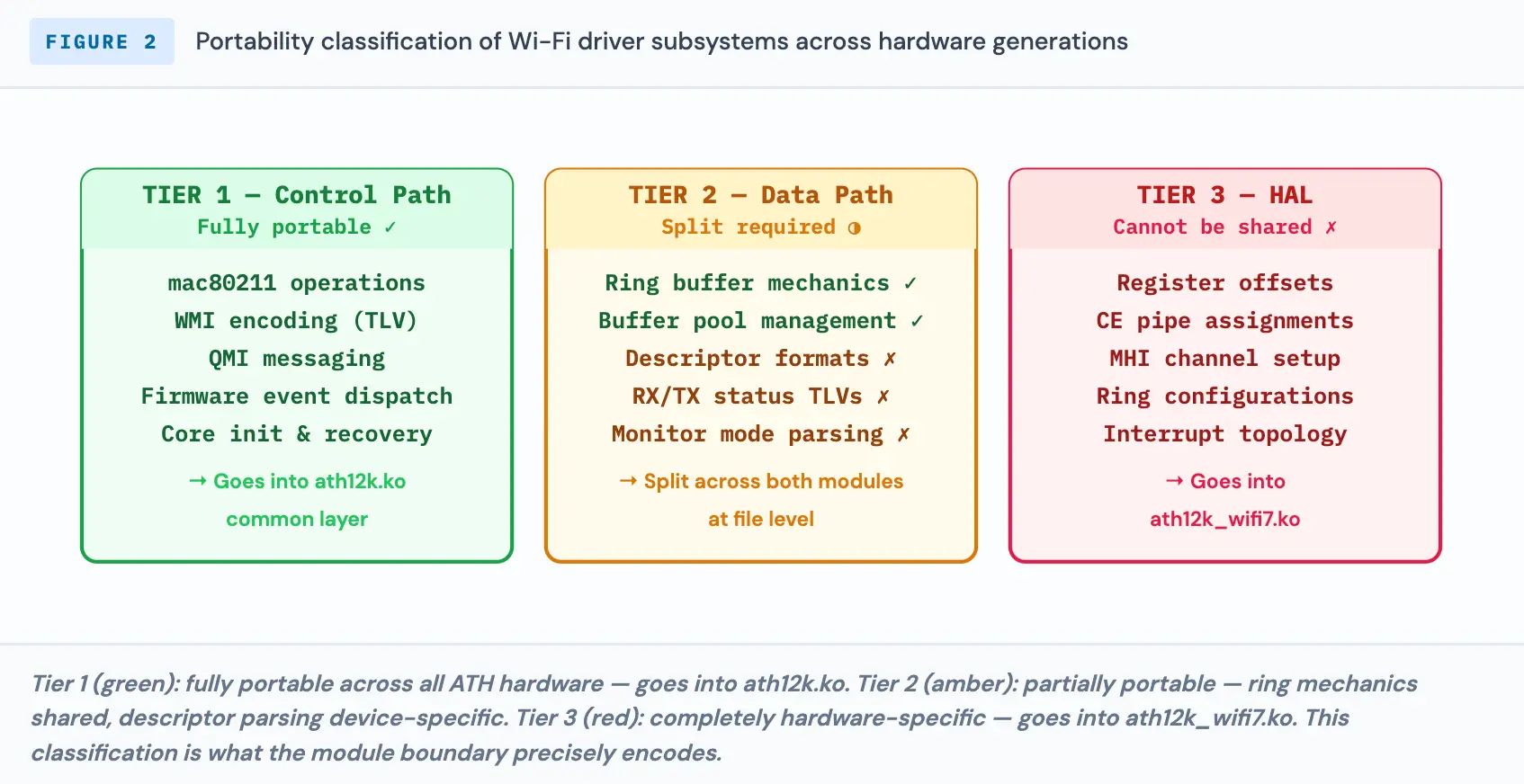
Before any architectural decision, you need precision about what "shared" actually means — not all driver subsystems are equally portable across hardware generations.
Key Insight
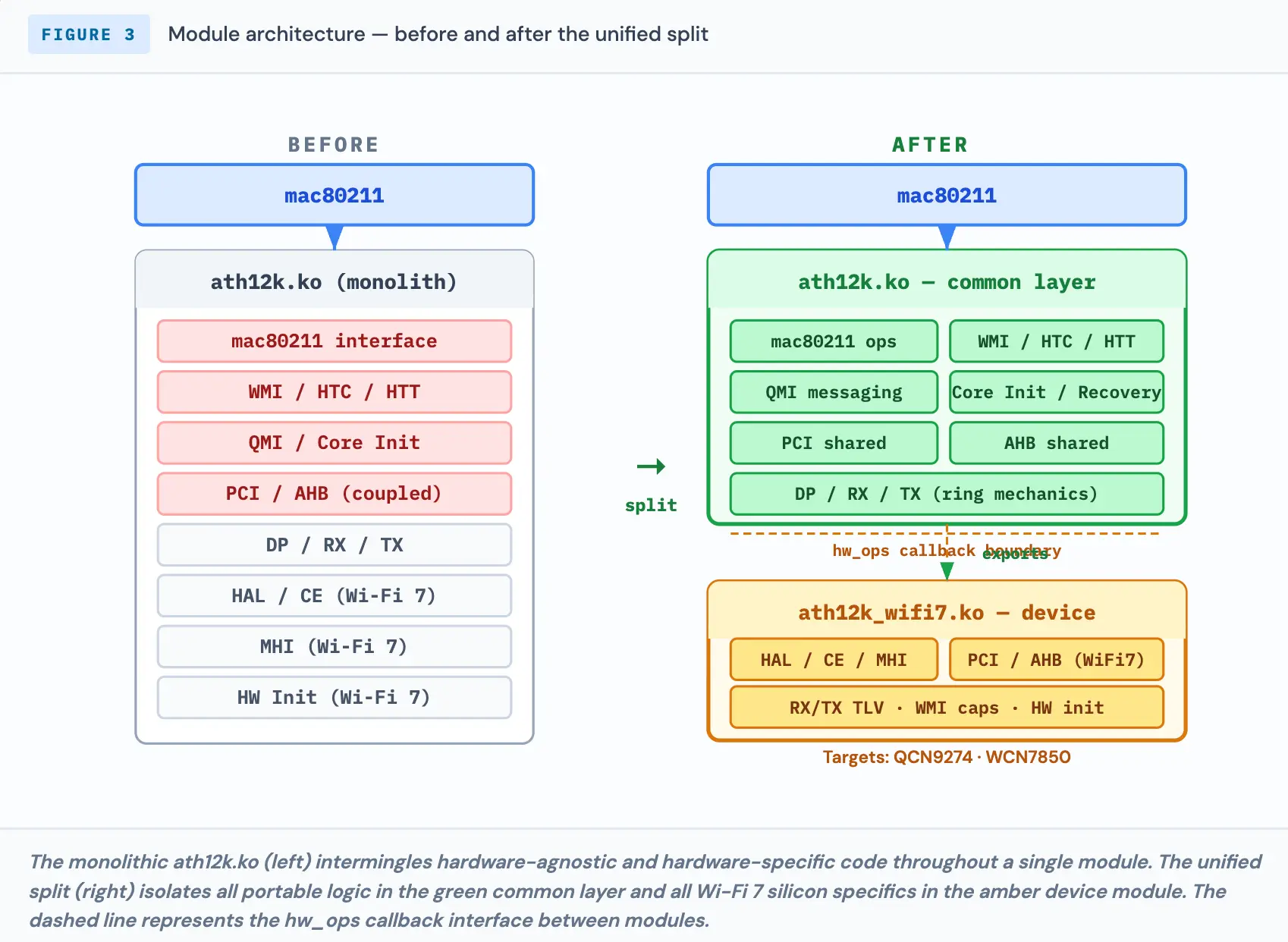
The unified driver model is not simply a code-sharing exercise. It is a precise encoding of the three-tier portability classification into the module boundary itself. ath12k.ko owns Tier 1 entirely and the portable half of Tier 2. ath12k_wifi7.ko owns the hardware-specific half of Tier 2 and all of Tier 3.
Architecture
Two Modules, One Platform
The core change is a split of the monolithic ath12k.ko into two distinct kernel modules. The split precisely follows the Tier 1/2/3 portability classification. ath12k.ko owns everything hardware-generation-agnostic: the mac80211 interface, firmware messaging stack, shared data path, and core init sequences. ath12k_wifi7.ko owns everything tied to Wi-Fi 7 silicon: HAL register offsets, Copy Engine pipe assignments, MHI channel setup, Wi-Fi 7 firmware capability TLV negotiation.
Directory Structure
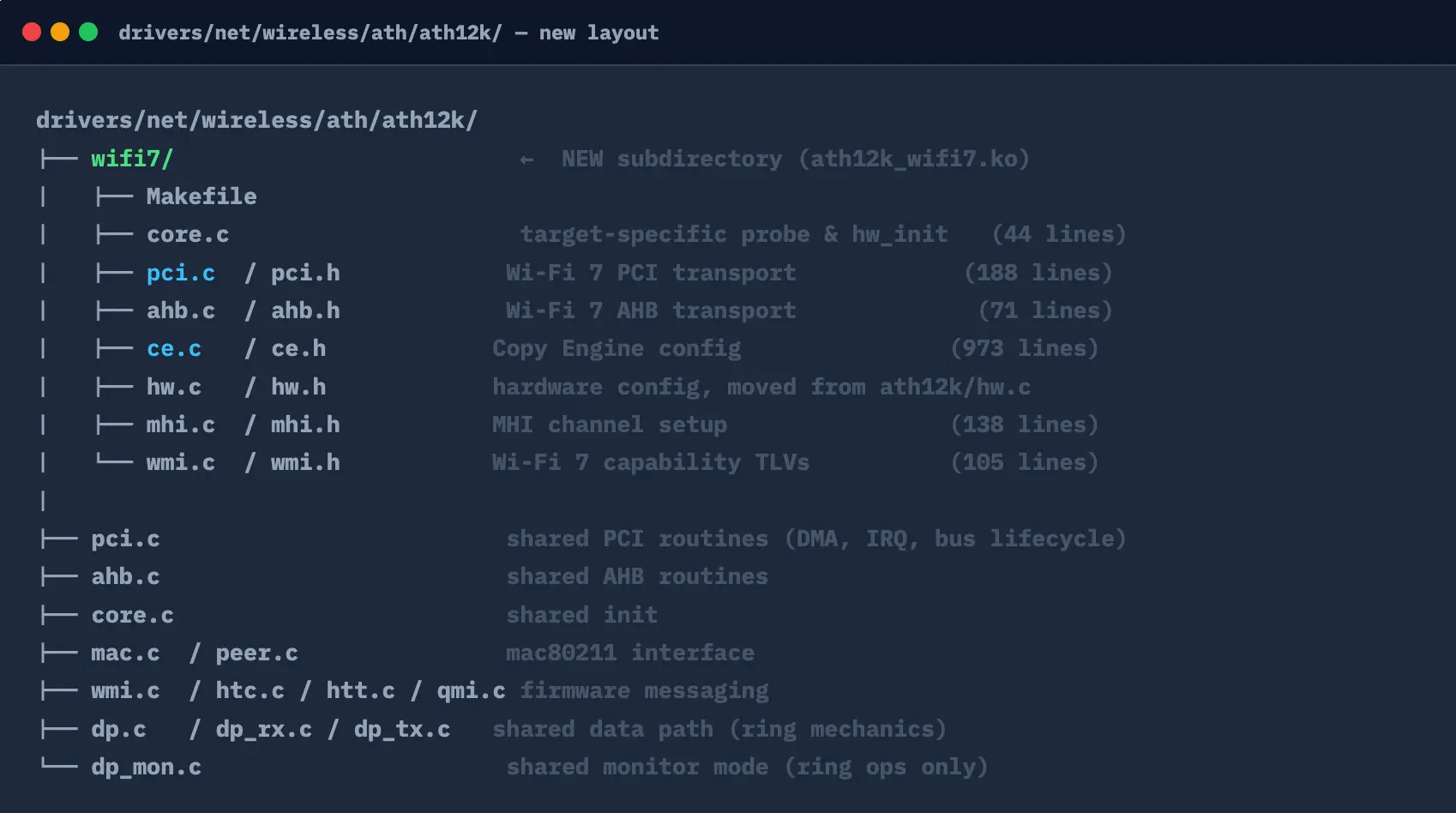
The module boundary is reflected directly in the filesystem layout. A new wifi7/ subdirectory is introduced, containing all device-specific code for the Wi-Fi 7 hardware generation.
HIF Decoupling
When a future Wi-Fi 8 chipset arrives, the team implementing ath12k_wifi8.ko does not rewrite DMA management or PCIe enumeration. They implement new register offsets in wifi8/pci.c and inherit everything else. The PCI bus driver in the common layer already knows how to talk to the kernel.
Data Path & Monitor Mode
Where the Boundary Gets Subtle
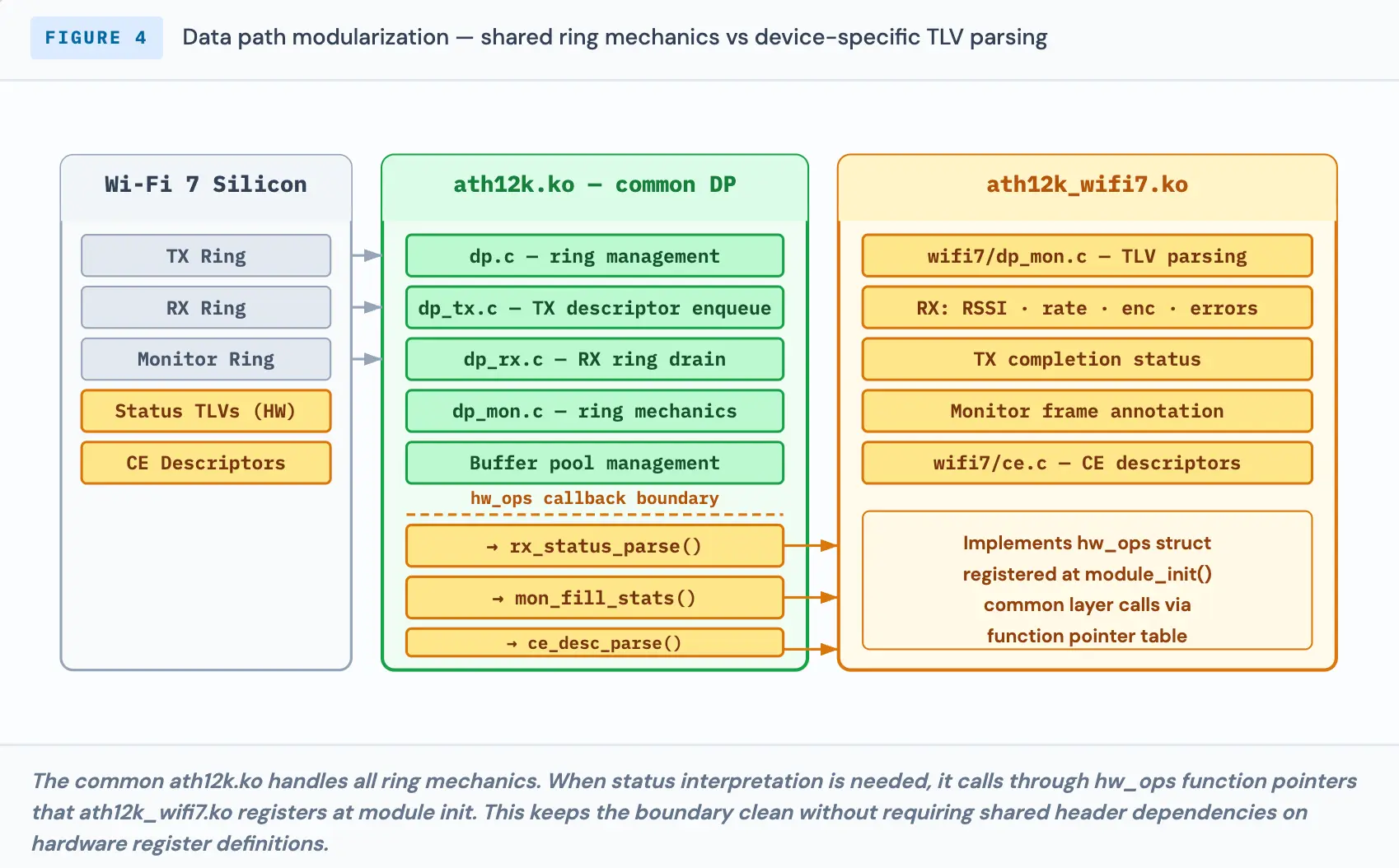
Packet movement — enqueuing descriptors into TX rings, draining RX rings, managing buffer pools — follows the same structural pattern across hardware generations and lives in the shared dp.c, dp_rx.c, and dp_tx.c. What varies between generations is the interpretation layer: RX status TLVs, monitor mode frame annotation, and CE descriptor parsing are all hardware-format-specific.
Implementation
13 Patches, Sequenced with Intent
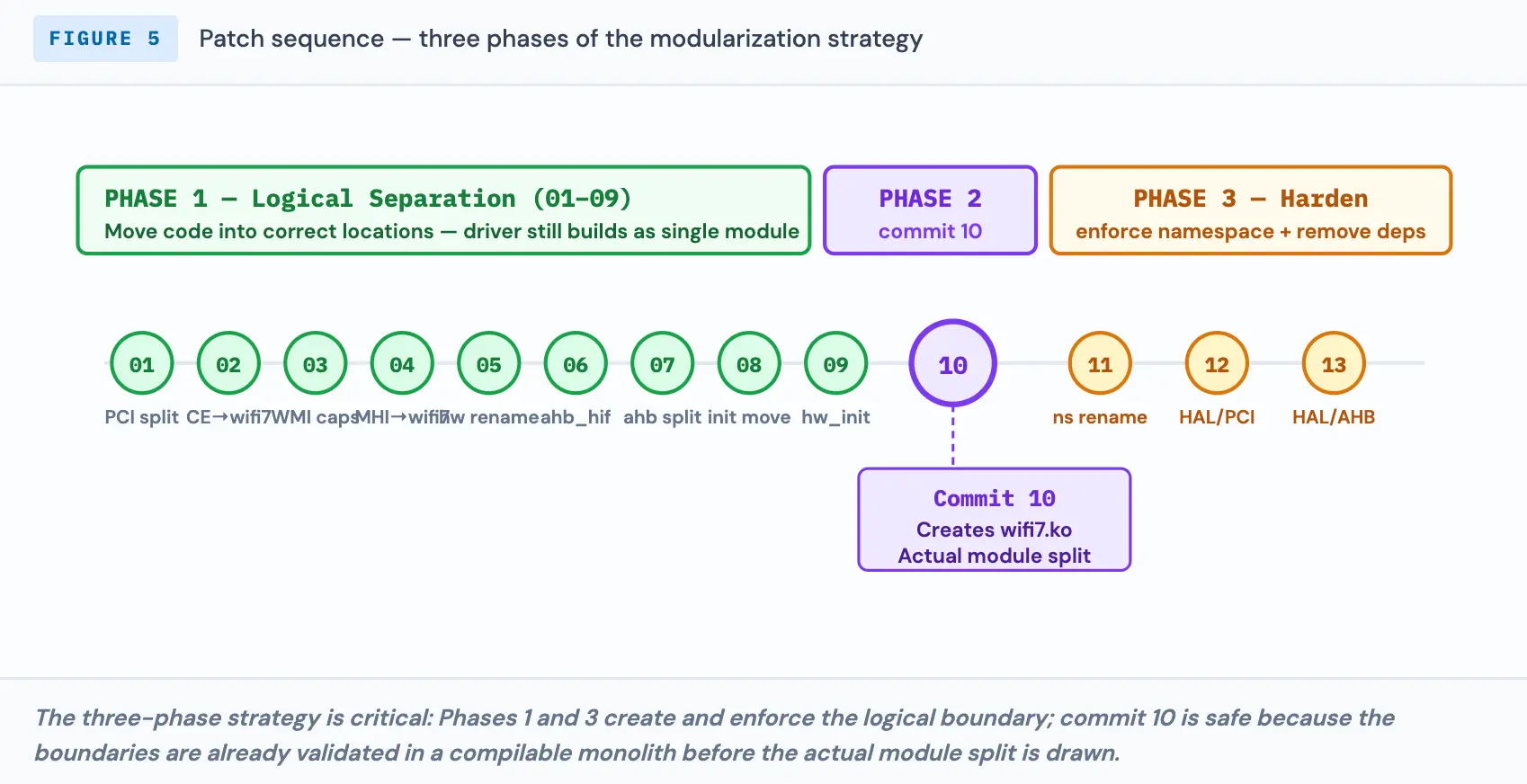
The implementation was delivered as 13 commits to the ath12k-ng branch. The commit ordering is deliberate: establish logical separation first, then draw the module boundary, then harden it. Commits 01–09 validate the separation within a still-compilable monolith. Commit 10 draws the actual module boundary. Commits 11–13 enforce it by eliminating cross-dependencies.
| # | Commit | What changes | Phase |
|---|---|---|---|
| 01 | Restructure PCI code | Separates generic PCI routines from Wi-Fi 7 specifics | SEPARATE |
| 02 | Move CE configuration | Copy Engine pipe assignments go to wifi7/ce. c. | SEPARATE |
| 03 | Move WMI capabilities | Wi-Fi 7 firmware TLV negotiation to wifi7/wmi. c. | SEPARATE |
| 04 | Move MHI configuration | PCIe MHI channel setup to wifi7/mhi. c. | SEPARATE |
| 05 | Rename hw.c | Explicit rename to signal Wi-Fi 7 specificity | SEPARATE |
| 06 | Rename ahb_hif_ops | Symbol renamed to reflect generic reusability | SEPARATE |
| 07 | Restructure ahb.c | Split into shared routines and Wi-Fi 7 specific | SEPARATE |
| 08 | Move Wi-Fi 7 init routines | Device-specific init consolidated in wifi7/ | SEPARATE |
| 09 | Move hw_init invocation | Routed through target-specific probe function | SEPARATE |
| 10 | Modularize the driver | Creates ath12k_wifi7. ko as a distinct kernel module. | SPLIT |
| 11 | Rename ath12k_* symbols | ath12k_wifi7_* namespace — prevents future collisions | HARDEN |
| 12 | Remove HAL defines from PCI | Eliminates remaining cross-dependency in shared PCI code | HARDEN |
| 13 | Remove HAL defines from AHB | Eliminates remaining cross-dependency in shared AHB code | HARDEN |
Change Statistics
13
commits to ath12k-ng
33
files changed
1956
lines added new wifi7/ structure
1480
lines removed consolidation
+476
net lines total delta
Why +476 Net Signals Discipline
A refactor that adds significantly more code than it removes often signals over-engineering. A net addition of only 476 lines across a 33-file refactor suggests the design is extracting existing structure rather than imposing new abstraction layers. The largest new file is wifi7/ce.c at 973 lines — justified, since Copy Engine configuration is one of the most hardware-specific parts of any Qualcomm Wi-Fi driver.
Future Extensibility
A Platform, Not a Driver
ath12k.ko is not a Wi-Fi 7 driver with shared code extracted into a library. It is a platform designed to host multiple device-specific modules. The extensibility model has three identified target classes and one implied long-term convergence path.
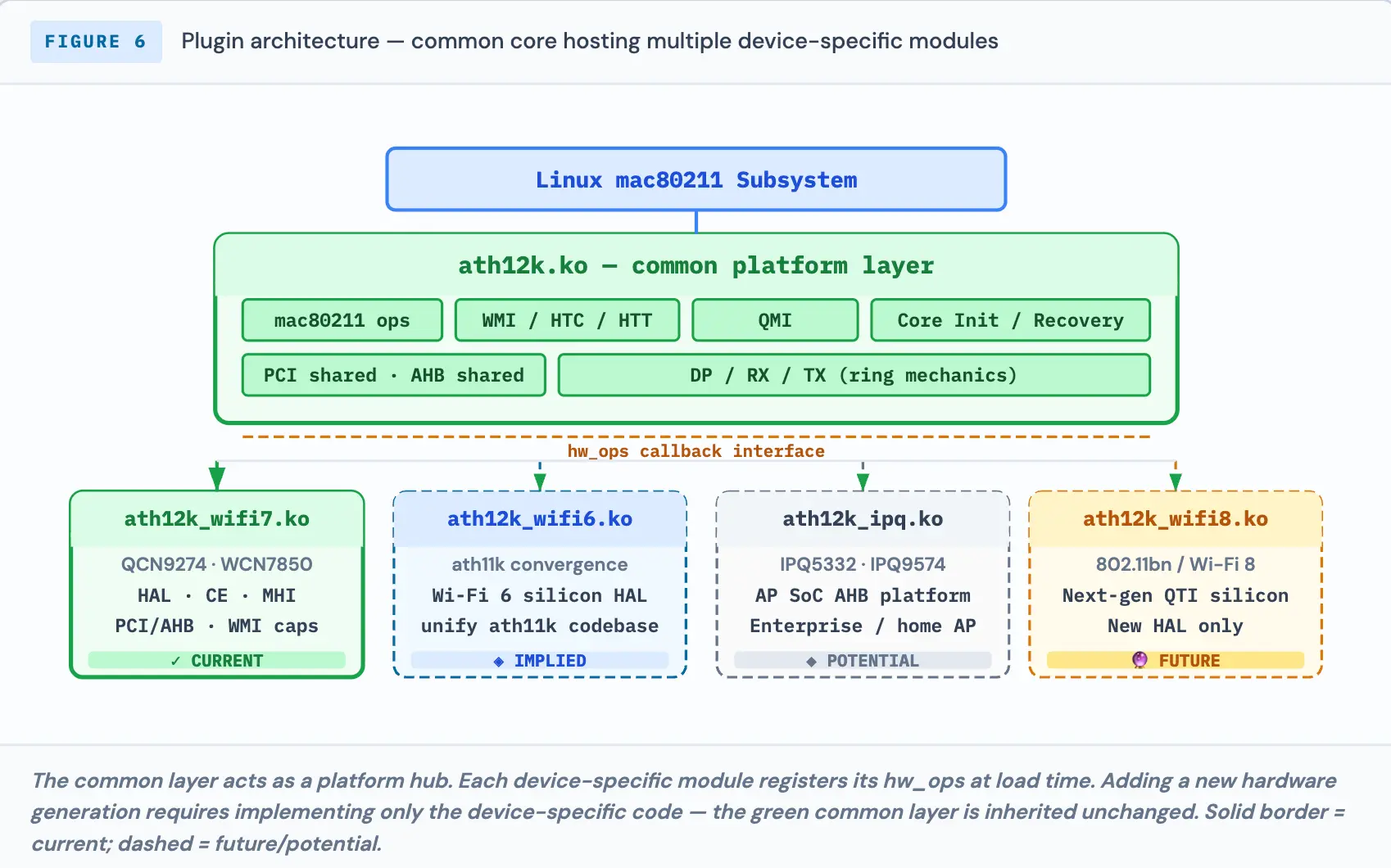
The most strategically significant implication is the potential to unify ath11k and ath12k under the same common infrastructure via a future ath12k_wifi6.ko. If realised, ath11k.ko could eventually be deprecated — collapsing two independently maintained drivers into one.
Upstream Risk
The Linux wireless maintainers have historically been cautious about unifying driver families. Any ath11k convergence would need to demonstrate zero regression on all existing Wi-Fi 6 hardware — a substantial validation burden that the phased delivery model is designed to address incrementally.
Upstream Path & Conclusion
What Needs to Be True for Mainline
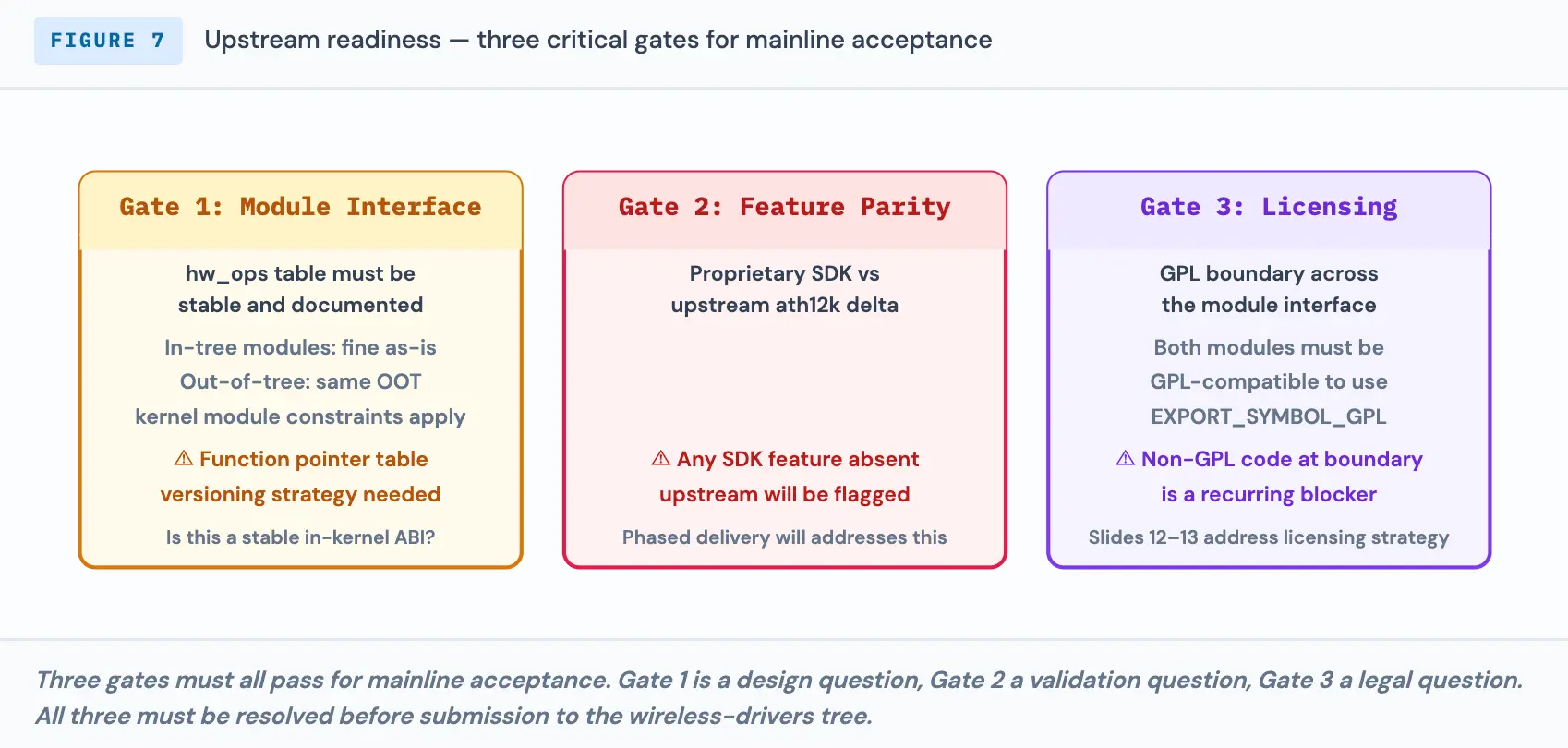
The ath12k-ng branch designation signals this is a staging ground, not yet in Linus's tree. The phased delivery suggests a rollout strategy that aligns feature parity with the proprietary SDK before pushing to mainline. Three critical gates determine upstream acceptance.
Legacy vs Unified — Maintenance Model
Conclusion
The ath12k unified driver model is one of the more architecturally coherent proposals to emerge from the Qualcomm wireless driver team in recent times. It takes a real problem — the generational code duplication that has plagued the ath driver family since ath9k — and addresses it with a structural solution proportionate to the problem: 476 net lines of change, 13 commits, a clean module boundary, an explicit extensibility model, and a sequencing strategy that validates the separation before drawing the boundary.
The immediate value is reduced maintenance overhead for Wi-Fi 7 hardware. The longer-term value is a living driver platform that absorbs new Qualcomm Wi-Fi silicon by implementing only what is genuinely new — the HAL register layout, the CE configuration, the MHI channel setup — while inheriting a decade's worth of hardened firmware interface and 802.11 state machine code from the common layer.
That is the difference between a driver and a platform.
Bottom Line
The right time to solve generational driver duplication is at the transition to a new Wi-Fi standard — when a new driver would have been written anyway. The incremental cost of the modular split over a clean new driver is modest. The compounding return across future hardware generations is substantial.
Recommended Blogs

14 May 2025
5 min read
Exploring Zephyr RTOS: A Lightweight, Scalable Real-Time Operating System for the Modern IoT Era
16 Jun 2026
5 min read
The Connected Device Revolution: Why Engineering Complexity Is Increasing Faster Than Ever
11 March 2026
5 min read
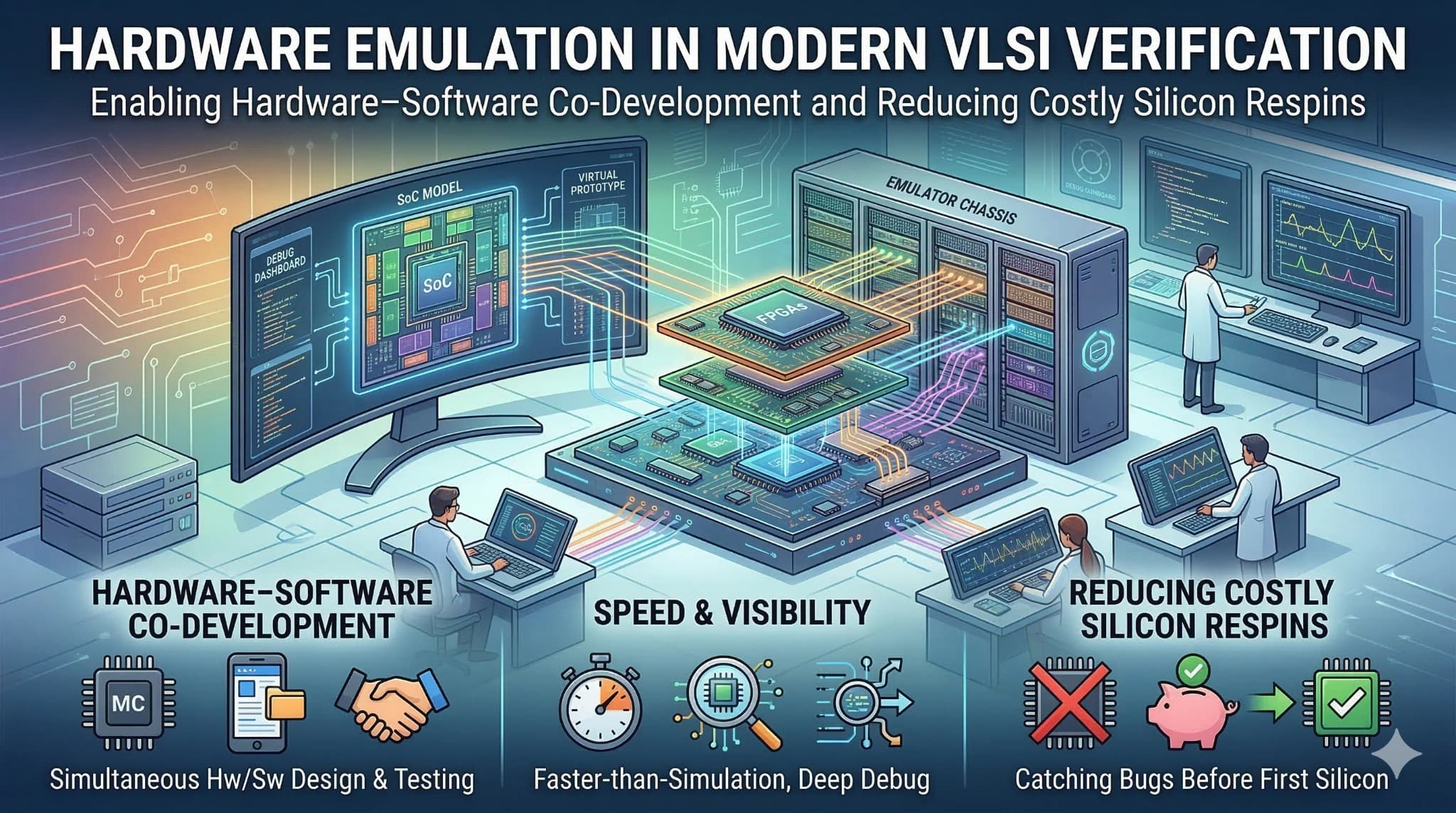
Hardware Emulation in Modern VLSI Verification: Enabling Hardware–Software Co-Development and Reducing Costly Silicon Respins
Build with the Most Trusted Engineering Partner

Delivers cutting-edge embedded solutions, from firmware development to wireless protocols, ensuring reliability and innovation.

Resources
Copyright © 2026
Privacy Policy
Terms of Service
Delivers cutting-edge embedded solutions, from firmware development to wireless protocols, ensuring reliability and innovation.


Resources
Privacy Policy
Terms of Service
Copyright © 2026