


30 Jul 2026

5 min read
The Software-Defined Cockpit: Why Modern Cars Became Giant Smartphones
-Aerlync Team
30 Jul 2026
5 min read
The Software-Defined Cockpit: Why Modern Cars Became Giant Smartphones
-Aerlync Team
The Software-Defined Cockpit: Why Modern Cars Became Giant Smartphones
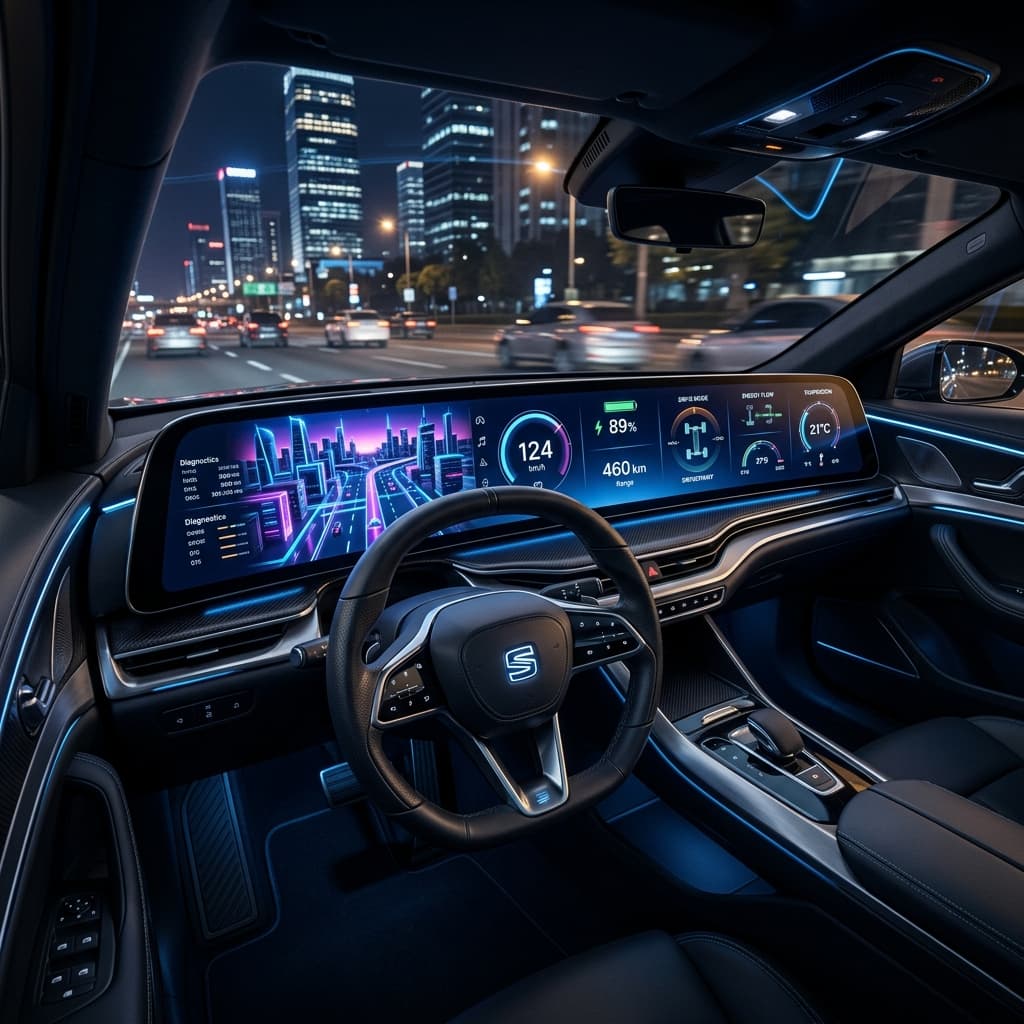
If someone from 2005 stepped into a 2026 vehicle, the biggest surprise would not be the electric powertrain or advanced driver assistance systems—it would be the dashboard. Physical buttons have almost disappeared. Climate control, mirror adjustments, lighting preferences, navigation, media, and even glove box controls in some vehicles are now accessed through a central touchscreen.
At first glance, this looks like a design trend inspired by smartphones. In reality, it represents one of the biggest architectural shifts in automotive engineering over the past decade. Modern vehicles are rapidly evolving into software-defined platforms where functionality is increasingly delivered through software rather than dedicated hardware.
The Age of Dedicated Controls
For nearly a century, automotive design followed a straightforward principle: every function had a dedicated physical interface. Knobs, switches, rotary encoders, and stalks offered immediate tactile feedback, allowing drivers to operate controls without taking their eyes off the road. Human factors research consistently shows that tactile controls reduce cognitive workload because they rely on muscle memory rather than visual confirmation.
However, this approach came with significant engineering overhead. Every new button required additional wiring, PCB space, connectors, tooling, validation, supply-chain management, and manufacturing complexity.
Tesla’s Architectural Shift: From Hardware to Ecosystems
Tesla popularized the idea that a vehicle should behave like a continuously improving software product. Instead of adding new hardware for every feature, it centralized vehicle functions into a high-performance computing platform with a large touchscreen interface.
The idea quickly spread across the industry because the business case was compelling. According to McKinsey, software-enabled features could contribute hundreds of billions of dollars in annual automotive value by the end of the decade, while software-defined vehicles are becoming the industry's primary innovation platform.
This is precisely the direction the SDV market is scaling toward. Forecasts vary—some analysts peg the global SDV market above $170 billion in 2026 growing toward roughly $950 billion by 2033, others project a jump from roughly $315 billion in 2025 to nearly $575 billion by 2032—but they agree the growth is being pulled by ADAS integration, 5G connectivity, and centralized zonal computing architectures that let automakers ship faster OTA updates.
Why Automakers Prefer Touchscreens
A modern touchscreen replaces dozens of individual components with a single computing platform.
Instead of manufacturing numerous switches, bezels, rotary controls, dedicated wiring harnesses, and separate controller modules, manufacturers integrate a display, a powerful SoC, graphics software, and a common operating platform. New functionality can then be deployed through software rather than mechanical redesign.
This significantly reduces manufacturing complexity while enabling platform reuse across multiple vehicle models.
OTA Updates Changed the Ownership Experience
Vehicles are increasingly updated like smartphones. Over-the-air (OTA) software updates allow manufacturers to deliver new features, UI improvements, battery optimization, ADAS enhancements, navigation updates, cybersecurity patches, and bug fixes without requiring a dealership visit.
Industry analysts estimate that connected vehicles capable of OTA updates now account for a rapidly growing share of new vehicle production, making software maintenance a strategic differentiator rather than an after-sales service.
Centralized Computing Is Replacing Distributed ECUs
Traditional vehicles often contained more than 70–100 Electronic Control Units (ECUs), each responsible for a specific subsystem. Modern zonal and centralized architectures consolidate these functions onto fewer high-performance processors, reducing wiring weight, improving software maintainability, and simplifying system integration.
This transition is fundamental to the Software-Defined Vehicle movement and is reshaping embedded engineering roles across the industry.
But There's a Catch: Human Factors Still Matter
While touchscreens improve flexibility and reduce hardware complexity, they also introduce usability challenges. Independent studies by organizations such as Euro NCAP and the Swedish automotive magazine Vi Bilägare have shown that touchscreen-heavy interfaces can increase the time drivers spend looking away from the road compared to physical controls.
As a result, several manufacturers are reintroducing physical controls for high-frequency functions such as hazard lights, volume, defrost, and climate adjustment. The future is not 'all touch'—it is a balanced human-machine interface that combines tactile controls, voice assistants, haptic feedback, steering-wheel inputs, and intelligent automation.
What Embedded Engineers Should Take Away
The evolution of modern vehicle interiors offers valuable engineering lessons:
- Software is becoming the primary differentiator. Expertise in Embedded Linux, AUTOSAR, RTOS, middleware, graphics frameworks, OTA infrastructure, and cybersecurity is increasingly essential.
- User experience is now an engineering responsibility. Performance alone is not enough; systems must also be intuitive, safe, and responsive.
- System architecture matters more than individual features. Understanding centralized computing, functional safety (ISO 26262), inter-process communication, and secure software deployment is becoming a core competency.
- Reliability remains non-negotiable. Automotive software must continue operating under vibration, temperature extremes, and strict safety requirements without compromising critical functions.
- Simplicity is engineered—not designed away. Replacing ten buttons with one screen is easy; creating an interface that is safer, faster, and more intuitive requires exceptional systems engineering.
Conclusion
The transition from buttons to touchscreens was never just about aesthetics. It was driven by manufacturing efficiency, centralized computing, software scalability, OTA capabilities, and changing customer expectations. Yet the industry's recent shift toward hybrid interfaces demonstrates an equally important lesson: technological advancement must always be balanced with usability.
For embedded engineers, this transformation extends beyond automotive systems. Every design decision is ultimately a trade-off between cost, performance, maintainability, safety, and user experience. The engineers who understand those trade-offs—and know when software should replace hardware and when it should not—will shape the next generation of connected products.
Recommended Blogs
11 March 2026
5 min read
Hardware Emulation in Modern VLSI Verification: Enabling Hardware–Software Co-Development and Reducing Costly Silicon Respins

06 Jul 2026
5 min read
The Strategic Connectivity Framework: Navigating Wireless Technology Selection in 2026

15 Oct 2025
5 min read
Edge AI: Intelligence at the Frontier of Computing
Build with the Most Trusted Engineering Partner

Delivers cutting-edge embedded solutions, from firmware development to wireless protocols, ensuring reliability and innovation.

Resources
Copyright © 2026
Privacy Policy
Terms of Service
Delivers cutting-edge embedded solutions, from firmware development to wireless protocols, ensuring reliability and innovation.


Resources
Privacy Policy
Terms of Service
Copyright © 2026